Get Full Government Meeting Transcripts, Videos, & Alerts Forever!
Get email alerts on the WESIP Budget topic
No spam. Unsubscribe anytime.
SFPUC seeks $217.7 million supplemental appropriation for Water System Improvement Program; commissioners press for environmental and contracting details
Summary
The San Francisco Public Utilities Commission heard a WESIP quarterly update and approved a $217,736,000 supplemental appropriation for 2007; commissioners pressed staff on environmental review delays, contractor prequalification goals, and how planning funds for watershed work will be spent.
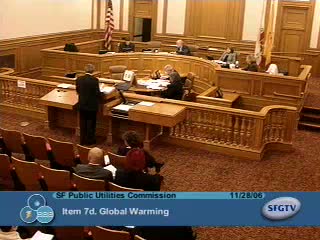
The San Francisco Public Utilities Commission on Nov. 28 approved a supplemental appropriation request totaling $217,736,000 to fund the Water System Improvement Program (WESIP) for calendar year 2007, commissioners said. The appropriation was presented by Tony Irons, who told the commission the program forecast for 2007 is about $299 million and that a remaining balance of roughly $82 million will cover ongoing staff and contract encumbrances.
Commissioners focused their questions on two program risks: a lag in the environmental phase of several projects and a thin pool of contractors bidding on work. Julie Labonte, WESIP director, said program reporting currently shows the environmental phase behind plan because earlier budgets charged some environmental costs to planning; her office is rebaselining schedules and cost-loading environmental tasks at the activity level and has added six dedicated environmental-review staff and a pool of environmental consultants to speed review and improve data accuracy by the end of the year. “We are currently undertaking a major rebaselining, cost-loading at the activity levels of all our environmental schedules,” Labonte said.
On contracting, Irons and Labonte described a two-phase prequalification program launched in October that will restrict bidding on certain local projects to prequalified contractors starting Jan. 1 and expand to regional projects in 2007. Irons said the move aims to increase the number of qualified bidders by making project packages larger and more attractive to major contractors while using subcontract and joint-venture provisions to include smaller firms. “We expect the prequalification process to become much better and to have more contractors bidding,” Irons said. Commissioners asked staff to map upcoming projects by discipline against the number of prequalified contractors so the commission can see whether the program will generate sufficient competition for each specialty.
Environmental-advocacy groups urged the commission not to let construction outpace environmental assurances. Heather Dempsey of the Tuolumne River Trust noted earlier commitments tied to the Watershed Environmental Improvements Program and said the appropriation contains roughly $500,000 for planning but that the watershed coordinator position had not been filled. “We remain very concerned that the construction part of the WESIP is moving ahead while the environmental assurances and stewardship activities are lagging behind,” Dempsey said. Commissioners asked staff to report back in January on the coordinator hire and the program management plan.
The commission approved the appropriation and related consent items by voice vote. No roll-call tally was recorded in the meeting transcript; commissioners indicated approval with vocal ‘Aye’ responses. Staff said they will return with a status report on the prequalification program, a discipline-by-discipline schedule of prequalified contractors, and refined information on environmental staffing and expenditures.