Get Full Government Meeting Transcripts, Videos, & Alerts Forever!
Get email alerts on the Language Access topic
No spam. Unsubscribe anytime.
Police commission hears language‑access briefing; community urges faster on‑scene interpretation and broader outreach
Summary
SFPD and the Office of Citizen Complaints reviewed Department General Order 5.2o on language access; presenters described translated materials and language‑line services, while community members and advocates pressed for faster on‑scene interpretation, more cell phones for officers, quality control and proactive outreach to monolingual residents.
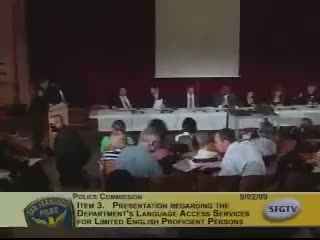
At a September 2 community meeting in Chinatown, the San Francisco Police Department and the Office of Citizen Complaints presented the departments language‑access program under Department General Order 5.2o, adopted in October 2007.
Lisa Torres, the departments language access liaison officer, described steps taken to implement DGO 5.2o, including a coalition with community groups, translated brochures in five languages, dual language‑line handsets at district stations, and training for officers. "This order was adopted in 10/16/2007," she said, and outlined available bilingual staffing and the departments use of a language‑line for languages beyond the certified bilingual officers.
Alyce Nicholson of the Office of Citizen Complaints reviewed the DGOs development and noted that the commission approved the policy on 10/17/2007. She said OCC has tracked internal use of interpretation and has translated brochures in Chinese, Spanish, Russian, Tagalog and Vietnamese.
Community advocates and residents praised the policy but described implementation gaps. Speakers and advocates highlighted three recurring problems: speed (on‑scene interpretation can be delayed while a sergeant retrieves a department cell phone for language‑line access), quality control (telephone interpretation may not substitute for face‑to‑face interpretation in sensitive cases), and outreach (many monolingual residents are unaware of the policy and of how to file complaints). Angela Chan of the Asian Law Caucus urged continued monitoring and better data collection on language‑access demand and fulfillment.
The department responded that language‑line services are free and that officers should attempt direct bilingual contact first, then use certified civilian interpreters or the language line. Officials acknowledged remaining gaps in equipment and budget constraints, and commissioners and OCC staff discussed community reporting days and targeted outreach so bilingual officers can meet tenants in their buildings.
The commission closed public comment on the item after collecting a range of community suggestions and asked staff and OCC to return with monitoring results and recommendations for improving speed, quality, and outreach.