Get Full Government Meeting Transcripts, Videos, & Alerts Forever!
Get email alerts on the Wsip Peir topic
No spam. Unsubscribe anytime.
PUC says WSIP PEIR delayed to after new year; commissioners press staff to guard critical-path permits
Summary
Deputy General Manager Tony Irons said the Water System Improvement Program's program-level EIR (PEIR) will likely be published after the first of the year to ensure thorough CEQA analysis; commissioners expressed concern over schedule slips on projects including Calaveras Dam and Alameda siphons and asked staff to pursue remediation.
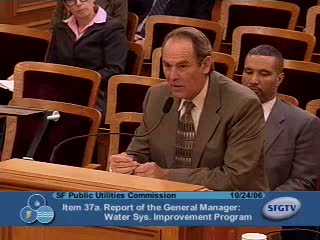
The San Francisco Public Utilities Commission received an update on Oct. 24 about the Water System Improvement Program (WSIP), including a likely delay in the publication of the program EIR and ongoing concerns about schedule slips on major projects.
Deputy General Manager Tony Irons told commissioners that the PEIR, once expected in November, will likely be published after the new year to allow more thorough analysis of water impacts on watersheds and source supplies. Irons said the delay is not due to lack of resources or coordination but rather to ensure the CEQA document is comprehensive and defensible. He emphasized that project permitting and project-specific EIRs — not the PEIR in most cases — remain the critical path for construction start dates.
Commissioners asked for clarification on several projects where environmental-review slips were shown in the report. They noted a six-month delay in environmental review for Alameda siphons and slips on Calaveras Dam schedule milestones. Staff replied that construction float exists for Calaveras and that federal permits and ESA/endangered-species reviews often govern timing; staff committed to close monitoring and remedial actions where possible.
Next steps: staff will continue coordination with City Planning and permitting agencies, provide follow-up details on schedule slips at commissioner requests, and produce an appropriation document and an economic-impact report before the draft PEIR.