Get Full Government Meeting Transcripts, Videos, & Alerts Forever!
Get email alerts on the Wifi Poles topic
No spam. Unsubscribe anytime.
PUC proposes $99.48-per-pole rate for WiFi attachments, commissioners demand aesthetic review
Summary
PUC staff recommended charging about $99.48 per pole per year to rent streetlight poles for city WiFi attachments; commissioners said aesthetics must be addressed and indicated the commission will require approval of pole attachment designs before leases are accepted.
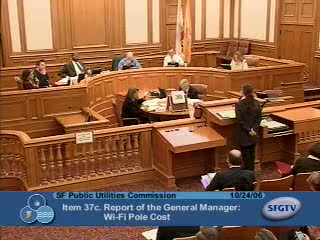
The San Francisco Public Utilities Commission heard staff recommendations on Oct. 24 to charge private WiFi providers a cost-based rental rate for use of PUC-owned streetlight poles and stressed that aesthetic considerations would be required before final approval.
Barbara Hale, assistant general manager for Power, told the commission staff had calculated a proposed rental rate of $99.48 per pole per year using the American Public Power Association's methodology and by examining rates charged by other cities. Hale said the proposed rate is intended to be cost-recovery based and that Mike Brown of finance ran the valuation.
Commissioners pressed staff on two priorities: (1) make the permitting and leasing process as easy as possible for vendors so the city’s WiFi rollout proceeds; and (2) require that antenna designs be aesthetically acceptable. Several commissioners described the current vendor prototypes as "ugly" and said the commission will not approve pole attachments that damage the look of the city. Staff agreed to pass the aesthetic guidance to the Department of Telecommunications and Information Services (DTIS) and to check parity between PUC and PG&E pole charges.
Deputy city attorney and staff clarified that any pole lease or attachment agreement would typically return to the commission for approval, providing an opportunity to review aesthetics and rates before agreements are finalized.
Next steps: staff will forward the aesthetic feedback to DTIS, complete any cross-checks on comparable rates, and bring lease language and attachments back to the commission for approval.