Get Full Government Meeting Transcripts, Videos, & Alerts Forever!
Get email alerts on the Sewer Master Plan topic
No spam. Unsubscribe anytime.
PUC outlines sewer master plan with four major alternatives; commissioners press for quantified low‑impact options
Summary
San Francisco PUC staff presented a draft Sewer System Master Plan that lays out four alternatives — upgrade, decentralized treatment, Oceanside consolidation, and relocation — while commissioners pushed for quantified analysis of low‑impact development measures and clearer project timelines. Public commenters urged environmental‑justice safeguards and alternatives to the Southeast plant.
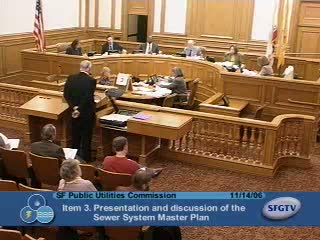
San Francisco Public Utilities Commission staff presented a draft Sewer System Master Plan Nov. 14 that examines how the city will keep its sewer system in a “state of good repair” for the next 30 years and respond to rising tides, aging pipes and regulatory change. Project lead John Liaquineau told commissioners a draft with costs and quantitative evaluations will be presented in February, with environmental review expected in early 2009.
The master plan lays out four broad alternatives: upgrading the existing system (including improvements to the Southeast plant); a decentralized option creating three dry‑weather plants and diverting flow (the Cayuga diversion) to the ocean; consolidating treatment at the Oceanside plant; and relocating the Southeast plant to a bayside site. Staff said the options trade neighborhood impacts, redundancy and regulatory flexibility against cost and constructability.
Commissioners pressed staff to provide clearer, quantified estimates of the effects of low‑impact development (LID) measures — such as street trees, planter boxes and permeable pavement — on stormwater volume and overflow reduction. “We asked six months ago for a calculation,” Commissioner Werbach said, seeking an estimate of how much stormwater would be reduced by a hypothetical $200 million investment in LID. Staff said LID modeling requires sewershed‑specific calibration and that preliminary estimates were modest (staff cited an initial reduction estimate of less than 10 percent unless implemented at very large scale), and that cost‑benefit figures will be included with the February analysis.
Public comment following the presentation emphasized sustainable approaches and environmental justice. Jennifer Clary of Clean Water Action and Alex Landsberg, co‑chair of the Citizens Advisory Committee, urged that sustainable watershed objectives be quantified and that past inequities from earlier plans be addressed. Several members of the public suggested alternative sites for treatment and pilot projects in city‑owned parcels.
Staff highlighted near‑term work: targeted inspection and replacement programs for the oldest sewers (noting roughly 75 miles of brick sewers), pilot odor‑control vent stacks along the Embarcadero, and initial measures to study tidal backwater and rising‑tide risks. Commissioners asked staff to present examples from other cities (Seattle, Sydney) and to return with both the “back story” on technical work and the bottom‑up project and cost allocations that will feed the programmatic budget.
The commission did not take a final action on the master plan at the Nov. 14 meeting; staff will return with a draft document, project lists and cost evaluations in February and a schedule for environmental review thereafter.