Get Full Government Meeting Transcripts, Videos, & Alerts Forever!
Get email alerts on the Marijuana Enforcement topic
No spam. Unsubscribe anytime.
SFPD outlines enforcement, fire risks and prosecutions tied to illegal marijuana grows
Summary
Captain O'Leary told the Police Commission that SFPD has investigated multiple illegal marijuana grow operations this year, cited fire and safety hazards from faulty wiring and said prosecutors have pursued felony charges in some cases; commissioners pressed the department on distinctions between medicinal and illicit grows.
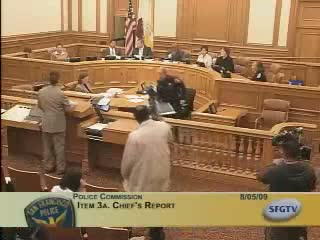
Captain Larry O'Leary of the San Francisco Police Department's Narcotics Division told the Police Commission on Aug. 5 that investigators have seen a rise in illegal marijuana grow operations in residential neighborhoods and warehouses and highlighted public-safety risks tied to faulty wiring and violent crime.
"There had been 18 cases presented to the narcotics division this year alone, 10 of which resulted in an arrest," O'Leary said, summarizing the unit's caseload and describing photographs of a warehouse fire on Shafter Street where handmade ballasts and faulty wiring caused a blaze that injured a firefighter.
O'Leary said many illegal grows are discovered after other incidents — fires, assaults or community tips — and often involve sophisticated operations that use filtration systems and timers to conceal odor and occupancy. He told commissioners the department follows a policy laid out in a department bulletin (cited by staff) to distinguish medicinal grows from illicit operations.
On prosecution, O'Leary said cases have been pursued under state health-and-safety statutes (transcript cites Health and Safety Code section cited during the meeting) and that the district attorney’s office has sought felony charges in some matters. He also said the City Attorney's office has pursued code-abatement remedies in certain properties.
Commissioners pressed for detail on how the department differentiates medicinal from illegal grows and how much investigative time is devoted to these cases. O'Leary said the narcotics unit dedicates a minority share of its investigative work to marijuana — "I doubt if it's more than 10% in the narcotics division as far as investigations" — but added residential grows pose heightened fire and safety risks that merit follow-up.
On the scale and value of seized plants, O'Leary said street price estimates for locally grown marijuana were about $3,000 per pound and that investigators often use the number of grow lights as a proxy for production. "Each light is probably good for a pound," he said, explaining how seizures of dozens of lights can represent significant quantities.
The presentation prompted questions about neighborhood impacts, whether houses had been converted entirely into grow sites, and whether organized groups or gangs were involved; O'Leary said many properties are rented and he did not yet have comprehensive data on gang involvement.
The commission did not take action on enforcement priorities during the meeting. Commissioners said they intend to follow up as the policy discussion continues.