Get Full Government Meeting Transcripts, Videos, & Alerts Forever!
Get email alerts on the Procurement Contracts topic
No spam. Unsubscribe anytime.
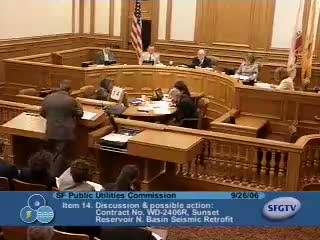
PUC affirms staff, awards Sunset Reservoir renovation contract to Shimek after protest
Summary
After a contested public protest, the San Francisco PUC voted unanimously to affirm staff’s recommendation and award the Sunset Reservoir structural renovation contract to Shimek; protestors alleged bid noncompliance on subcontractor listings and concrete qualifications, but staff and the city attorney said post-bid vetting showed the apparent low bidder met requirements.
The San Francisco Public Utilities Commission on Sept. 26 voted to affirm staff’s recommendation to award the Sunset Reservoir structural renovation contract to Shimek following a public protest alleging bid defects. The commission’s decision came after an extended hearing on bidder responsiveness and contractor qualifications.
Tim McInerney, representing West Bay Builders, urged the commission to reject the award, contending Shimek’s bid failed to comply with the solicitation by not listing a fencing subcontractor that would both supply materials and install the fence and by submitting an insufficient concrete subcontractor qualification statement. “To allow Shimek to ignore the specific sections gives them an unfair advantage,” McInerney said, arguing the procurement specifications required a single installer with specific experience.
Randall Smith, attorney for Shimek, disputed that characterization and argued the subcontractor listing and public contract code thresholds permitted the approach Shimek used. “We have submitted a quote from that subcontractor, which is Bailey Fence. It’s a licensed contractor whose qualifications have not —” Smith said, adding the labor component fell below the listing threshold in the bid forms.
Deputy General Manager Tony Irons and the city attorney explained the PUC’s bid review process: initial screening for budget responsiveness, a concurrent Human Rights Commission (HRC) review for DBE/goal compliance, and a staff responsibility check of qualifications. Irons said the first bidding round drew five bids; two were above project budget and three failed to meet HRC goals. HRC reviewed goals and recommended lowering the DBE target from 11% to 8% for a rebid, which produced four bids that met HRC requirements.
On questions about missing references and post-bid supplementation, staff reported it had conducted follow-up checks with subcontractor clients and concluded the nominated waterproofing/concrete subcontractor met specification requirements. The city attorney reiterated that some elements of responsiveness are objective (for example, mandatory bid bonds), while qualifications or responsibility can be investigated after bid opening and validated by staff.
After hearing argument from both sides, a commissioner moved to accept the staff recommendation; the motion was seconded and approved unanimously. The commission’s formal action affirms the staff award to Shimek and directs project teams to proceed with contract execution consistent with PUC procedures.
The commission record shows the protest centered on two claims: the fencing installation/material linkage in the specification and whether the concrete subcontractor had the five projects in the last five years required by the bid documents. Staff concluded the fencing subcontractor proposed for Shimek held the required C-13 license and that the concrete subcontractor’s qualifications were verified during post-bid review. West Bay Builders declined the commission’s legal authority to substitute its judgment for staff and the city attorney on responsiveness questions.
Next steps: staff will proceed with final awards and contract administration; parties to the protest retain other administrative or legal remedies outside the commission’s award decision.