Get Full Government Meeting Transcripts, Videos, & Alerts Forever!
Get email alerts on the Crime Statistics topic
No spam. Unsubscribe anytime.
Police report shows homicide rate down 52% in first half of 2009; commissioners seek deeper breakdowns
Summary
San Francisco Police Department officials told the Police Commission that homicides fell 52% in the first six months of 2009 and presented other declines; commissioners requested more detailed analysis by zone, demographic impact and comparisons to national trends.
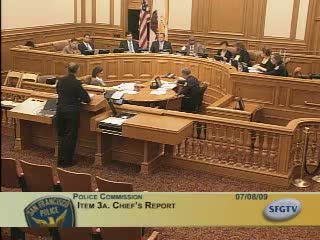
San Francisco police officials told the Police Commission on July 8 that violent-crime statistics for the first six months of 2009 show substantial declines in several categories, including a 52% drop in homicides, and announced an expanded report in coming weeks.
"The most outstanding thing you can see is that the homicide rate is down 52%." The statistic was shown to commissioners during a condensed presentation of a department press release; presenters said a fuller six-month and an 18-month review will be presented at subsequent meetings.
The department gave other preliminary figures: rapes down about 10 percent, robberies down about 25 percent, aggravated assaults down roughly 6 percent, larcenies down 13 percent and vehicle theft down 17 percent, while burglaries were slightly up. Presenters also said nonfatal shootings citywide were down overall but up in some zones, and emphasized that the number of victims in certain shooting incidents can be larger than the number of incidents.
Commissioners pressed for more detail. "I would really like to take the opportunity as best we can...to figure out what's going on here," one commissioner said, urging the department to provide analysis of which tactics and community actions appear to be producing results and whether declines are distributed evenly across neighborhoods and demographic groups.
Department leaders credited a combination of factors, including a focused enforcement plan, staffing increases at district stations, interagency and federal partnerships and community cooperation. Assistant and field commanders also highlighted increased gun seizures and targeted operations with prosecutors as contributing elements.
What happens next: The department said it will deliver a comprehensive six-month summary next week and an 18-month evaluation in mid-August that will examine tactics, staffing, prosecutions and community engagement to clarify drivers of the decline.
Why it matters: Commissioners noted the scale of the homicide drop is uncommon nationally and requested disaggregated data—by zone, by victim/offender demographics and by incident type—to guide continued strategy and public messaging.