Get Full Government Meeting Transcripts, Videos, & Alerts Forever!
Get email alerts on the Disciplinary Hearing topic
No spam. Unsubscribe anytime.
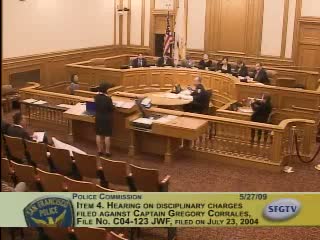
Police Commission declines to sustain charges against Captain Gregory Corrales in long-running 'Fajita Gate' case
Summary
After a two-day administrative hearing and closed-session deliberations, the San Francisco Police Commission voted 6–1 on May 27, 2009, not to sustain disciplinary charges against Captain Gregory Corrales alleging violations of Department General Orders 8.09 and 2.01; commissioners said the OCC failed to meet its burden of proof.
SAN FRANCISCO — The San Francisco Police Commission voted 6–1 on May 27, 2009, not to sustain disciplinary charges against Captain Gregory Corrales arising from his public comments during an internal investigation known in the record as the "Fajita Gate" matter.
The vote followed closing arguments from the Office of Citizen Complaints (OCC) and the defense, a procedural dispute over whether a taped station meeting should be played during closing argument, and a private deliberation in closed session. The commission also voted 6–1 to withhold specifics of its closed-session deliberations.
OCC counsel Cicely Gray urged the commission to consider print statements attributed to Corrales and argued the captain’s comments—published in Chronicle articles—“tend[ed] to bring discredit upon his department,” were made before investigative reports were completed and risked undermining the investigators’ work. Gray told commissioners that comments calling a victim’s statement “ludicrous” and saying investigators were “bending way over backward” reflected opinions outside Corrales’ personal knowledge and were inappropriate in that context.
Defense counsel Michael Fazio framed the case as one about free expression and the legal standard the OCC must meet. He argued the record did not show Corrales’ statements jeopardized the investigation and asked the commission to rule only on the specific charges. "Please exonerate him of all the charges," Fazio told the commission as part of his closing remarks.
Before deliberations, the commission rejected 6–1 a defense request to play a taped statement from a prior station commission meeting as part of closing argument, with commissioners expressing concern about admitting new testimonial material at the closing-argument stage.
After returning from closed session, the commission announced it would not sustain the charges against Corrales (file C04-123). Lieutenant Riley conducted a public roll-call vote: the motion to "not sustain" carried by a 6–1 margin. The commission explained in part that the OCC had charged the allegations under overlapping provisions and, in the majority’s view, had not met the burden of proof on the elements required under DGOs 8.09 and 2.01.
Commissioners’ post-vote remarks reflected differing perspectives. Several said they were troubled by aspects of the conduct described in the record and urged clarification or revision of the department general orders that govern officers’ communications with the media. Others stressed the need to protect officers’ ability to speak publicly while also ensuring guidance to avoid undermining investigations or public trust.
Captain Corrales spoke after the decision and said he had not violated the two cited general orders and was "vindicated" by the ruling. Commissioners announced they would not disclose the specifics of their closed-session deliberations and closed the agenda item. The commission then moved to remaining closed-session personnel matters and adjourned at roughly 9:15 p.m.
What’s next: Commissioners suggested revisiting Department General Orders 8.09 (media communications) and 2.01 to provide clearer parameters about what public statements by officers are appropriate during ongoing investigations, especially as the department transitions to new leadership.