Get Full Government Meeting Transcripts, Videos, & Alerts Forever!
Get email alerts on the Civilianization topic
No spam. Unsubscribe anytime.
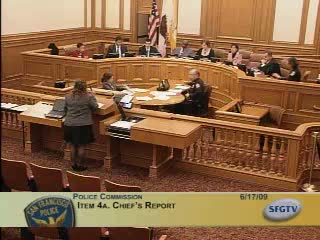
Commission hears civilianization plan as budget uncertainty forces trade-offs
Summary
San Francisco Police Commission received an update on efforts to convert some sworn positions to civilian roles and pressed department leaders on costs, background checks, and whether civilianizing now would be cheaper than recruiting and training new officers amid a projected city budget shortfall.
The San Francisco Police Commission on Monday heard an update on a multi-year effort to "civilianize" certain Police Department functions, a program staff say could free sworn officers for patrol work but that is constrained by funding and background-check limits.
Alice Villegas, the department's Human Resources director, told commissioners the civilianization initiative stems from city-charter directions and management audits. "The goal of civilianization is to appropriately identify jobs that could be converted from uniformed police to civilian in the police department, enabling uniformed police to be reassigned to perform peace officer work," Villegas said, summarizing budgeted positions and hires across fiscal years.
Villegas outlined the program's history and numbers: 124 positions were identified in prior audits, 121 were included at some point in budgets, and in the current year 19 new positions were added to the budget with 14 hires to date. Commissioners pressed for comparisons to national benchmarks; one commissioner cited a PERF study showing 23–25% civilian staffing in comparable urban departments versus about 15.8% locally.
Much of the discussion focused on practical limits. Staff said roughly 57 employees classified as "accommodated" (non–full-duty) and about 35 officers currently in administrative assignments limit immediate redeployment opportunities. Villegas estimated approximately 100 positions in the department could be civilianized in principle, but stressed that hiring is constrained by background checks, funding timing and the Board of Supervisors' budget process.
Budget uncertainty is a central constraint. Commissioners referenced a joint report that identified a projected citywide shortfall (the commission discussed a $428,000,000 figure reported by staff), and department presenters said midyear cuts and an ongoing hiring freeze have limited the ability to fund civilian positions now. Budget staff said some equipment replacement will be supported through lease financing in the mayor's submission (40 marked vehicles, 20 motorcycles for the Solos and 10 for the Honda unit), but that final outcomes would depend on the Budget Committee hearings the next day.
Commissioners requested clearer, position‑by‑position cost comparisons — specifically whether converting existing assignments to civilian titles and redeploying officers to field work would be cheaper than recruiting lateral officers and training new academy classes. Staff agreed to provide updated analyses after the budget hearings.
A member of the public, Barbara Gross, also addressed the commission during public comment, questioning whether some functions (for example, traffic or parking enforcement) should be civilianized and raising separate concerns about Muni fare collection practices.
The commission did not take a formal vote on a civilianization policy at the meeting; commissioners directed staff to return with more precise cost and redeployment data tied to the upcoming budget hearings.