Get Full Government Meeting Transcripts, Videos, & Alerts Forever!
Get email alerts on the Fair And Impartial Policing topic
No spam. Unsubscribe anytime.
Fair and Impartial Policing project briefs commission after Supervisor Campos hearing; focus groups and new screening proposed
Summary
Dr. Laurie Bridal outlined the Fair and Impartial Policing Project's training, screening and community outreach work in response to a recent Supervisor Campos hearing on perceived racially biased policing; she described new applicant-screening plans, roll-call training on implicit bias, and neighborhood focus groups to rebuild trust.
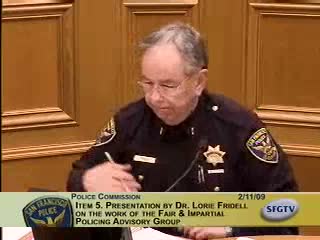
Dr. Laurie Bridal, who leads the department's Fair and Impartial Policing project, briefed the commission on steps being taken to address community concerns raised at a hearing convened by Supervisor Campos.
Bridal said the project combines training, revised applicant screening, focus groups and community outreach. She said recent work includes a new two-hour roll-call racial profiling update for in-service officers, development of screening tools with a consultant to promote impartial policing, and scheduled Spanish-language focus groups in neighborhoods that raised complaints. "We want to listen to what they are seeing... and what they perceive," Bridal said.
Bridal also described plans to incorporate portions of national training materials selectively, to prioritize elements that address bias and social psychology while omitting material she judged counterproductive. She said the project will invite community leaders to observe the training and continue focus groups, some without police present, to encourage candid feedback.
Commissioners asked whether community members who testified to the Board of Supervisors could be invited to testify to the commission and whether excerpts of training videos could be shared; Bridal said the department would use the strongest portions of existing materials in training and would work to schedule community dialogue and briefings.
Next steps: the project will continue the focus groups, roll out the two-hour training update over the coming months, and reach out to community leaders for joint training viewings and discussion.