Get Full Government Meeting Transcripts, Videos, & Alerts Forever!
Get email alerts on the Zone Violence Reduction topic
No spam. Unsubscribe anytime.
SFPD Presents One‑Year 'Zone' Violence‑Reduction Results; Commission Hears 35% Drop in Nonfatal Shootings in Targeted Areas
Summary
Deputy Chief Cashman and Chief Heather Fong presented a year‑one evaluation of the SFPD's zone‑based violence‑reduction strategy, reporting a 34% reduction in homicides within zones and a 35% drop in nonfatal shootings in targeted zones over the prior 12 months; the District Attorney's office described firmer charging practices and new prosecution resources.
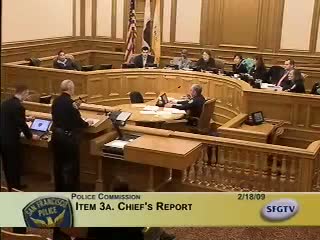
At the Feb. 18, 2009 San Francisco Police Commission meeting, Chief Heather Fong and Deputy Chief Cashman presented results from the first year of the SFPD’s zone‑based violence reduction strategy. Cashman said the approach — informed by research identifying concentrated hot spots of violent crime — used five targeted zones and a combination of tactics including fully staffed beats, specialized unit deployments, narcotics buy‑busts, fugitive apprehension, probation and parole compliance checks, stay‑away orders, gang injunctions, federal prosecutions and community outreach.
Cashman reported zone‑specific and citywide results the department described as significant: within the enforcement zones homicides decreased by roughly 34 percent and nonfatal shootings fell by about 35 percent year‑over‑year. He cited specific zone outcomes: nonfatal shootings in the Tenderloin reportedly fell from 25 to 11 (a 58% decline) and the Western Addition saw nonfatal shootings decline from 34 to 9 (about 73%). The SFPD also reported increases in arrests and seizures tied to the strategy: figures presented included hundreds of arrests in enforcement operations, firearm seizures rising from 1,091 to 1,230 (about a 13% increase), and 412 probation/parole searches with 325 resulting arrests under a grant‑funded effort concentrated in the zones.
Cashman explained tactics in practice: coordinated scheduling of specialized units (fugitive recovery, narcotics, gang task force, tactical teams), targeted buy‑busts that yield strong prosecutable cases, and the use of 10:35 search conditions and parole/probation tools to limit access to areas and weapons. He also described a new violence‑reduction coordinator role (Lieutenant Jim Miller) to link field operations with investigations and a shared database to distribute real‑time information across units.
Russ Giuntini, representing the District Attorney’s Office, told the commission the prosecutor’s office tightened charging practices for trafficking and violent cases in recent years and described a roughly 22 percent rise in felony filings and an increase in felony convictions over the same period, a change he attributed in part to better police‑prosecutor coordination. Giuntini described new prosecutorial supports for zone enforcement, a state‑funded cold‑hit DNA unit to act on CODIS matches, and weekly homicide roundtables to accelerate charging decisions.
Commissioners praised the cross‑agency collaboration but also raised concerns. Multiple commissioners urged stronger community notification and communication around high‑intensity enforcement to avoid perceptions of targeting or racial profiling, particularly in neighborhoods that reported friction during saturation patrols. Commissioners and public commenters noted concerns in immigrant communities about the interaction between enforcement and immigration consequences; Chief Fong stated that the department does not perform civil immigration enforcement and cited existing department orders and the city’s sanctuary ordinance as constraints on such involvement.
Several commissioners asked about sustainability and the ability to replicate zone results across more neighborhoods given resource limits. Cashman and staff said many zone activities used on‑duty resources, noted recent increases in sworn staffing that enabled the work, and said federal and grant funds had supported some elements (for example, a $750,000 grant for intensive Tenderloin enforcement). The department acknowledged the budget climate and said further evaluation and crime analysis would guide any expansion or contraction of zones.
Commissioners requested follow‑up briefings and additional data (clearance rates, arrest‑to‑charge conversion, impacts on non‑shooting violent crimes such as robbery and on specific communities). The commission scheduled additional agenda items and invited continued DA participation to report on charging and prosecution outcomes.