Berkeley evaluation finds cameras cut nearby property crime but not violent crime; San Francisco sets deadline for department plan
Loading...
Summary
A UC Berkeley team told the Police Commission that San Francisco's 71-camera Community Safety Camera Program produced roughly a 24% reduction in property crimes within ~100 feet of cameras but showed no measurable reduction in violent crime; commissioners requested departmental recommendations and cost estimates within a set timeline and opened discussion on storage, oversight, and community input.
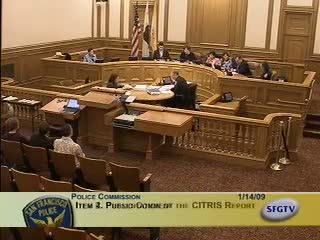
A UC Berkeley evaluation of San Francisco's municipally owned Community Safety Camera Program presented to the Police Commission found a measurable, localized effect on property crime but no measurable impact on violent crime.
Jennifer King, a researcher with UC Berkeley School of Law, told the commission the team studied ordinance requirements, camera locations and crime statistics around the 71 city-owned cameras, interviewed more than 30 stakeholders, conducted site visits and compared San Francisco's program with other cities. "We looked at the number of times SFPD requested copies of recorded images, the number of times images were used to bring criminal charges and the result of those charges," King said, summarizing the project's scope.
Professor Rafael, the team's quantitative lead, described three empirical strategies the group used to isolate camera effects, including exploiting the staggered timing of camera installations and comparing crimes reported in public versus private locations. "Within about 100 feet of the camera we did indeed find evidence on all fronts that property crime declined by a statistically significant amount," Rafael said. He summarized the effect roughly as a 24% decline in property crime concentrated in public-place larceny and theft (examples the team cited included thefts from cars, bike thefts and pickpocketing). "We found no impact on violent crime," he added.
The researchers cautioned the finding was narrow and empirical in scope: it captured changes in crime rates near camera locations, not indirect investigatory uses of footage, nor broader, harder-to-measure effects such as whether footage emboldens witnesses or helps prosecutors. "Some of the impacts are difficult to analyze," Rafael said, noting limitations of available data and the narrow question the study could answer.
The Berkeley team also reported operational and management shortcomings. Dietra Mulligan and other presenters said the program had grown from a pilot to 71 cameras without a formal technical design, requirements gathering, or user training. The team found footage retention averaged seven days despite a 30-day retention expectation noted in the commission's obligations, and that cameras were often recorded at roughly one to two frames per second rather than the 20'30 frames per second the researchers said is needed for reliable identification. King said DTS 's estimate to bring storage capacity into compliance with a 30-day retention standard was roughly $500,000.
Commissioners and staff discussed remedies and next steps. Ed Lee, the city administrator, thanked the research team and said city departments (DTIS, DEM and SFPD) would continue to support improvements. Lieutenant Giddens (SFPD), who the chief identified as the department's point person for the camera program, told the commission he had begun stakeholder meetings and would work on policies, procedures and technical fixes to address access, storage and coordination.
Commissioners said the most fundamental question is what the program's purpose should be going forward. Several members urged the department to recommend whether the system should prioritize violent-crime reduction, property-crime mitigation, concentrated hot-spot deployment or be decommissioned. The commission asked the department to return with a timeline, technical and cost estimates and a plan for community engagement; commissioners discussed a 60-day minimum for a substantive progress report.
Public testimony at the hearing was sharply divided. ACLU representatives and several residents urged removal or scaling back of the system, citing civil liberties and the program's limited impact on violent crime. Elizabeth Zitrin of the ACLU of Northern California said retaining cameras for a small property-crime gain was not the trade-off the public was promised when the program was approved. Other residents said they supported cameras in their neighborhoods to address day-to-day property crime.
The commission did not vote to keep or dismantle the system at the hearing. Instead, members directed the department and the lieutenant-appointed point person to provide a follow-up report with economic, operational and community-impact analyses and to return to the commission for broader public discussion if active monitoring is proposed. The commission also flagged the need for formal audits, clearer access protocols, improved training for investigators and consideration of concentrating cameras to increase effective coverage rather than spreading them thinly.
Commissioners and staff said several metrics would be crucial in the next report: a back-of-envelope dollar value for the property crimes apparently averted, a clear accounting of current and projected storage and maintenance costs, proposed changes to retention and frame-rate settings, and a plan for community outreach in hot-spot neighborhoods including Tenderloin, Mission and Western Addition.
The commission's deliberations will continue after the department's progress report; members said they were not prepared to reach a final policy decision without the requested cost, implementation and public-engagement detail.