Get Full Government Meeting Transcripts, Videos, & Alerts Forever!
Get email alerts on the Public Safety Homicide Stats topic
No spam. Unsubscribe anytime.
Police commission hears 2008 violence data: homicides steady, gun seizures surge to 1,228
Summary
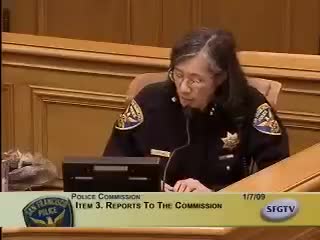
At its Jan. 7 meeting the San Francisco Police Commission heard department data showing 97 homicides in 2008 (down from 98 in 2007) while nonfatal shootings fell and gun seizures rose to 1,228; commissioners asked staff for clearance‑rate and demographic breakdowns.
The San Francisco Police Commission on Jan. 7 received a year‑end briefing from department leadership that showed roughly steady homicide totals for 2008 alongside significant reductions in nonfatal shootings and a sharp increase in gun seizures.
Commander Murphy told the panel that the city recorded 97 homicides in 2008 compared with 98 in 2007, and that nonfatal shooting incidents declined by 108 citywide year‑over‑year. "The officers in this in the police department are doing just a wonderful job," the commander said, praising seizure efforts.
Why it matters: Commissioners said the numbers show some operational successes but asked the department to provide deeper context so policy decisions — including prevention strategies and allocation of resources — are grounded in clearer evidence. The commission requested clearance rates and demographic and geographic breakdowns for future reports to assess whether declines in shootings correspond with reductions in particular types of homicides.
Details from the briefing include: the department reported a preliminary 108 fewer people shot in 2008 compared with 2007 (a 36 percent citywide decrease), and 1,228 guns seized in 2008 (roughly 100 per month). Commander Murphy noted an observed increase (about 42 percent) in homicide victims aged roughly 45–66 in the last year and said the department will further analyze where and how those homicides occurred (inside vs. outside, neighborhoods affected).
Commissioners asked for the following in follow‑up reports: clearance rates for homicides, demographic comparisons (for example homicides among Black males aged 25–35 as a percentage of both homicides and the population), and separate charts showing seizures and shooting incidents so the public can see each measure as a standalone trend.
The chief's office said the department will align a presentation to match the materials being shared with the Board of Supervisors Public Safety Committee and will provide more detailed quarterly breakdowns in February.
The commission did not take formal action on policy at the meeting; commissioners emphasized continued monitoring and directed staff to return with the requested analytic breakdowns.