Get Full Government Meeting Transcripts, Videos, & Alerts Forever!
Get email alerts on the Tenderloin Public Safety topic
No spam. Unsubscribe anytime.
Tenderloin captain credits zone enforcement and community trust for crime drops; residents press for loitering and services changes
Summary
Capt. Gary Jimenez told the Police Commission the Tenderloin saw declines in homicides and nonfatal shootings after saturation and mid‑market beat enforcement; residents thanked officers but urged more outreach, pushback on loitering and clearer services distribution.
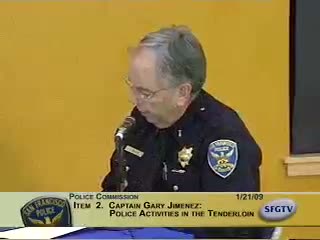
Captain Gary Jimenez told the San Francisco Police Commission on Jan. 21 that the Tenderloin Station’s saturation enforcement, foot patrols and private-camera footage helped reduce violent crime and improve arrest rates.
“This is a 41 page report,” Jimenez said, introducing charts that showed nonfatal shooting victims in the Tenderloin dropped from 25 to 13 and homicides fell to four — and he added that all four homicide cases resulted in arrests. He credited the drop to “the Chiefs program of saturation in the zone areas,” expanded plain‑clothes operations, mid‑market beat officers and strong cooperation from community members.
Commissioners praised the statistics but pressed for more detail. Commissioner David Onick asked whether arrestees were local; Jimenez said a community review of a three‑month sample found 17% of arrested persons listed Tenderloin addresses and 83% did not, and noted an observed crime drop during a BART shutdown.
Public commenters — including tenants, nonprofit directors and neighborhood advocates — told commissioners they appreciated the station’s outreach but urged more visible foot patrols near homes and businesses and stronger enforcement or ordinance changes to address persistent loitering and open‑air drug activity.
Edward Evans, a Tenderloin tenant, said General Order 5.3 limits officers’ authority to move loiterers and urged more coordinated city outreach. “We would like to see more outreach from the San Francisco Police Department, to the community organizations,” Evans said.
Several community leaders invited commissioners to walk tenderloin blocks or attend local board meetings to see conditions firsthand. James Keyes of the Mental Health Board and the Senior Action Network invited officials to site visits and suggested redistributing some services that cluster in the Tenderloin.
Jimenez also described station staffing and training: the station is a training post with recruits paired with field training officers, he said, and has nearly 21 multilingual officers. He acknowledged shortfalls in Latino officer representation and said the station has assigned bilingual liaisons and school‑liaison officers to expand outreach.
On assaults, commissioners noted a citywide rise in a category listed as “assaults.” Jimenez suggested improved reporting and greater trust in police may explain some of the increase, and he pointed to the Tenderloin’s homeless outreach and plain‑clothes work as part of a response.
Commissioners and community members repeatedly highlighted private‑sector cameras and liquor‑store footage as crucial evidence in investigations, and agreed that community partnerships helped solve cases quickly. Several speakers urged more cross‑agency coordination — including the Board of Supervisors on loitering ordinances — to address problems that enforcement alone cannot fully resolve.
The commission did not take formal action on the report; members directed staff to pursue more detailed statistics on domestic violence and to continue community meetings in the district.