Get Full Government Meeting Transcripts, Videos, & Alerts Forever!
Get email alerts on the Perfreport topic
No spam. Unsubscribe anytime.
PERF recommends broad organizational overhaul for SFPD; city leaders set January steering committee to prioritize implementation
Summary
An independent PERF review offers more than 200 recommendations to restructure the San Francisco Police Department, emphasizing community policing, investigations, information systems and leadership stability; city officials said a steering committee will meet in January to set priorities and pilots.
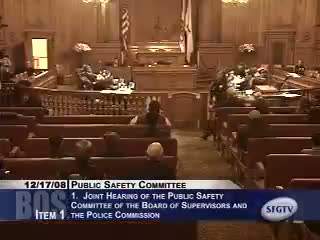
The San Francisco Board of Supervisors Public Safety Committee and the Police Commission on Wednesday received a 353-page organizational review from the Police Executive Research Forum that lays out more than 200 recommendations to reshape how the San Francisco Police Department works.
The report, PERF officials said, centers on four priorities: integrating community policing with problem-solving practices, improving investigative capacity, modernizing information systems and establishing an oversight-driven accountability process such as CompStat. "You don't get better by simply saying you're great," Chuck Wexler, PERF's executive director, told the joint hearing, emphasizing the study's focus on rigorous assessment and community input.
Why it matters: The consultants urged the city to pilot the package of reforms in one or two districts to test outcomes before scaling them citywide. That approach, they said, would allow San Francisco to define measurable objectives and the resources needed to reduce violence and improve neighborhood problem-solving. Craig Fraser, PERF co-presenter, described staffing policy options that range in cost and scope; one model focused on calls-for-service response would require about 268 additional patrol officers.
Key recommendations and department response - Community policing and accountability: PERF recommended making community policing a guiding department-wide philosophy tied to problem-solving (SARA) methods and a central CompStat-like system to measure progress. Fraser recommended district pilots to develop replicable templates rather than imposing a one-size-fits-all mandate. - Investigations and supervision: The report suggests restructuring the investigations bureau to increase specialization, lower supervisor-to-staff ratios (to about 1:7 or 1:8), and create civilian investigative-aid positions to free sworn investigators for field work. - Leadership and workforce development: PERF urged expanding mandatory rotation for sworn personnel, accelerating management development, and preparing for retirements: roughly 600 officers will be eligible for retirement in the next 3–4 years, the consultants said. - Technology and information use: The report calls for an information utilization plan, and recommends creating department CIO/CTO roles to turn raw data into timely operational decisions.
Chief Heather Fong said the department will prioritize recommendations that are cost-neutral or can be implemented with reassignments while the city faces budget constraints. "It's now incumbent on us to move forward to prioritize those simple things that can be quickly done that don't cost an extra penny," she told supervisors and commissioners.
Implementation, oversight and next steps City Controller staff are cataloguing recommendations, classifying them by cost and type (administrative change, ordinance, resource request) and preparing a steering-committee agenda for January to identify priorities and pilot opportunities. Peg Stevenson of the Controller's Office described a process to sort recommendations into short-term, pilotable actions and longer-term items that may require legislation or bargaining.
Officials emphasized that many administrative changes can begin immediately while larger policy questions will require joint decisions by the board, the commission, the mayor's office and, in some cases, labor negotiators. Wexler said that if the city selects a pilot district and secures consensus, implementation steps could begin within three to six months and yield measurable results.
Public reaction and oversight Public commenters and commissioners repeatedly urged prompt action, particularly in neighborhoods mentioned by residents such as the Western Addition, Bayview-Hunters Point, the Tenderloin and the Mission, where callers said trust has eroded. Several speakers underscored the need to coordinate SFPD efforts with school and community organizations and to preserve neighborhood precinct presences where residents credited them with quality-of-life improvements.
Next procedural step: the steering committee will meet in January to sequence priorities, identify cost-neutral actions and recommend pilot districts; no formal votes were taken at Wednesday's hearing.