Get Full Government Meeting Transcripts, Videos, & Alerts Forever!
Get email alerts on the Police Policy And Training topic
No spam. Unsubscribe anytime.
Police commission hears presentation on street encounters, reasonable suspicion and officer conduct
Summary
Department instructor John Evans briefed the San Francisco Police Commission on training and policy for pedestrian contacts, explaining the three categories of contacts (consensual, detention requiring reasonable suspicion, arrest requiring probable cause), the department's additional training hours, and the limits on when officers must disclose suspicion; commissioners raised concerns about perceived profiling and officers' tone during encounters.
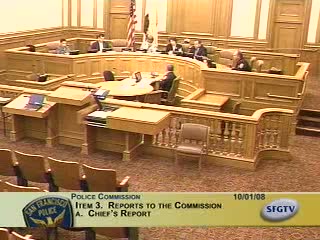
The San Francisco Police Commission on Oct. 1, 2008 heard a presentation and extended discussion about street encounters, investigative detentions and officer conduct.
John Evans of the San Francisco Police Department, introduced by the chief's office, said he has instructed pedestrian-contact training at the department academy for 12 years. Evans described the training block as a statewide mandate from the California Commission on Peace Officer Standards and Training and said the state requires a minimum of six hours of instruction in that block; the San Francisco Police Department provides eight hours at its academy. "Just about anything they want," Evans said when asked what a citizen may say during a stop, adding that speech may escalate or de-escalate an encounter.
Evans outlined three categories of police–citizen contact: a consensual encounter (the person is free to go), an investigative detention (which requires reasonable suspicion), and an arrest (which requires probable cause). He said reasonable suspicion — what a reasonably trained officer would see as grounds to investigate — is the legal trigger for a detention and that officers need articulable facts before taking away someone's freedom, even briefly. He also said searches during detentions are limited to circumstances where an officer can articulate facts that suggest the person may be armed or possess contraband.
On whether officers must immediately explain the basis for a stop, Evans said there is no written policy requiring a point-by-point explanation in every case, though he said good policing includes offering an explanation particularly if the person is not ultimately arrested. He noted that when a detention is lengthy or results in transport, a release is provided and referenced a penal-code release (transcribed in the record as "8 49 b of the California penal code").
Commissioners raised repeated community complaints that young men of color are stopped, questioned and searched without adequate explanation or justification, and they pressed staff about the tone of interactions. Evans said departmental general orders prescribe against profane language but acknowledged some officers argue communication tactics require different tones; commissioners said rough language can feel intimidating and asked the department to consider that in training and oversight.
No formal policy changes or votes were recorded at the meeting; the presentation and commissioners' questions constituted information-gathering and public discussion.