Get Full Government Meeting Transcripts, Videos, & Alerts Forever!
Get email alerts on the Public Safety topic
No spam. Unsubscribe anytime.
San Francisco police outline zone strategy as Mission District crime rises; residents demand more officers
Summary
At a Police Commission meeting in the Mission District, SFPD leaders described rising violent-crime trends and a zone-based enforcement strategy, said Mission Station staffing is roughly 105 officers, and pledged expanded outreach; residents urged immediate increases in patrols and better communication after recent homicides.
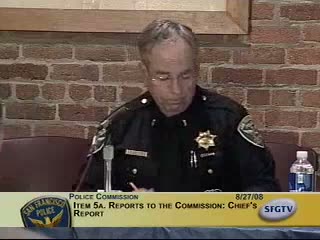
San Francisco Police leaders told the Police Commission at a Mission District meeting on Aug. 27, 2008, that violent crime in parts of the neighborhood has increased and that the department has shifted resources to a zone-based enforcement model to concentrate specialized units where violence is most concentrated.
Chief Heather Fong and Deputy Chief Kevin Cashman said the department’s new approach places an outsized number of resources in five priority zones — including the Mission — where a disproportionate share of violent crime occurs. Cashman described the strategy as layering specialized units (gang task force, narcotics, a violence-reduction motorcycle squad, Honda units and tactical teams) on top of sustained sector-car and foot-patrol coverage.
“Because there’s a disproportionately high level of violent crime in that 2%, we put a disproportionately high number of specialized resources in that area,” Deputy Chief Kevin Cashman said. Chief Fong described ongoing organizational reviews and said some units (marine, Muni response and certain canine teams) were reassigned to better align with homeland-security and field-operations duties.
Captain Steven Tacchini, who presented the Mission Station’s report, told the commission that robberies in parts of the Mission rose 12% — “that translates to 43 more robberies than we had during the same time last year” — and that calls for service have increased by about 1,100 per month (roughly 12%). He said the station has handled nine homicides so far in 2008 and has made substantial arrests: “I think we have 1,357 to date in 8 months,” Tacchini said, referring to arrests.
Tacchini said Mission Station currently fields about 105 officers and has prioritized foot patrols, outreach in Spanish, and a merged homeless-outreach and park-patrol team to move high-demand users into services. The captain also described tactical deployments after recent murders, including targeted plainclothes operations and immediate gang-task-force involvement.
Multiple commissioners pressed for clearer staffing benchmarks. Commissioner David Campos asked the department to analyze whether 105 officers is adequate in light of sharp increases in assaults and other crimes in particular parts of the district; Deputy Chief Cashman said staffing decisions are customized by station and that the department will include staffing analysis in the station report.
Residents at the meeting said they were alarmed and urged urgency. “We need the police commission to support the police officers … there should be a zero tolerance on guns,” said resident Tracy Brown, citing figures in the commission packet that showed an overall crime increase and a rise in felonies. Merchants and neighborhood block groups asked for better follow-up after shootings, more visible patrols, and concrete staffing numbers.
The department also signaled some near-term operational changes: moving Market Street foot-beat officers into a single location for briefings and consistent oversight, refining neighborhood-level crime reporting for public use, and continuing collaboration with the Human Services Agency, the district attorney and homeless outreach teams.
The meeting closed with commissioners asking the department to provide a written follow-up on staffing needs and to publicize the department’s neighborhood crime-reporting tools so residents can track trends and demand resources through community pressure.