Get Full Government Meeting Transcripts, Videos, & Alerts Forever!
Get email alerts on the Taraval Station Report topic
No spam. Unsubscribe anytime.
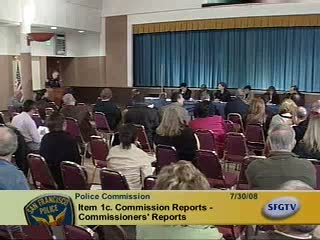
Taraval captain outlines community policing tools as commissioners probe crime spikes
Summary
Taraval Station Captain Paul Chignell reported on neighborhood outreach, daily email alerts, victim outreach and enforcement data; commissioners questioned recent increases in burglaries and larceny and sought deployment and analysis details.
Taraval Station Captain Paul Chignell told the Police Commission on July 30 that the station uses decentralized community policing, daily neighborhood emails and targeted enforcement to respond to local crime and nuisance issues.
Chignell said Taraval covers roughly 23% of San Francisco’s land mass and serves about 160,000 people. He described a system of 13 first-line supervisors who each liaise with neighborhood organizations and said the station has used strike-force overtime to address violent-crime patterns.
"We had a 176 robberies. We did make 33 arrests," Chignell reported, describing recent enforcement results and noting that many robbery arrests involved juveniles.
Commissioners pressed Chignell on large percentage increases reported in the inner Sunset neighborhood — a 30.42% rise in Part 1 crimes and nearly a 46% jump in larceny in some comparisons — and whether those shifts reflect real trend changes or low baseline counts. Chignell acknowledged burglary series earlier in the year and an increase in identity-theft reports; he said some theft spikes may reflect more reporting rather than a street-level surge.
Commissioners asked whether reallocating resources for surge enforcement in high-violence parts of the city leaves lower-crime districts underpoliced. Chignell said commanders and adjacent captains meet regularly to reallocate resources and that tactical deployments have reduced violence in some hot spots while creating management challenges elsewhere.
On neighborhood tools, Chignell highlighted a daily email list used by thousands of residents to share localized crime and traffic information and an ambassador program that contacts victims who otherwise receive no follow-up. He said the station expedites removal of long-unregistered vehicles — a task that can take months for other city departments — to give immediate neighborhood relief.
The session included requests for more detailed, district-level analyses and for follow-up reports that show how deployments changed outcomes. Chignell and staff said they are preparing a six-month report to document adjustments and results.
Next steps: Commissioners requested a follow-up briefing with detailed beat maps, job descriptions for foot-beat officers and the promised six-month deployment report.