Get Full Government Meeting Transcripts, Videos, & Alerts Forever!
Get email alerts on the Vision Statement topic
No spam. Unsubscribe anytime.
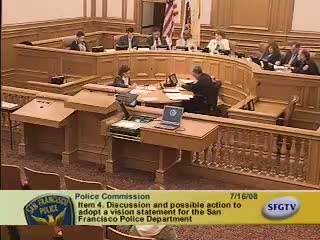
San Francisco Police Commission adopts vision statement after debate over transparency and diversity
Summary
The Police Commission voted July 16 to adopt a vision statement for the San Francisco Police Department, agreeing to minor edits to the supporting "about" text that clarify limits on disciplinary transparency and emphasize community engagement and implementation steps.
The San Francisco Police Commission adopted a vision statement for the Police Department on July 16 after commissioners spent hours debating language about transparency, diversity and how the document should guide future policy.
The commission voted to approve the text with amendments to the explanatory "about" material that, commissioners said, will clarify the department—s aspirational goals without promising changes that would conflict with existing law. Commissioner David Campos moved the motion and Commissioner Joe Marshall seconded; the motion passed by roll call vote and the commission announced the measure passed unanimously.
The vision statement grew from an organizational assessment conducted with the Police Executive Research Forum (PERF) and outreach led by the Comptroller—s Office. Catherine McGuire of the Comptroller—s Office described a stakeholder process that included interviews, focus groups, an online feedback tool translated into Chinese, Russian and Spanish, and more than 350 contacts across the city.
Assistant Chief Lynch, summarizing department input, said the statement "encompasses what San Franciscans expect about its police department and what the department expects of itself," and presented the vision as a guide for staffing, training and use-of-force review.
Several commissioners urged caution about the language in the supporting material that discusses accountability and transparency. Commissioner Petre De Jesus said the phrase "transparent" in the about text was misleading under current disciplinary disclosure rules: "The word transparent is just not accurate." Assistant Chief Lynch and consultants from PERF said the vision was aspirational and could describe a future state the department would pursue while operating within the constraints of current law.
Commissioners agreed to amend the descriptive text to make clear that efforts to increase transparency would proceed "to the greatest extent practicable under current law" and to add clarifying language about recruiting and training a workforce reflective of San Francisco—s diversity. The commission also asked staff to circulate the revised "about" text and to continue outreach as the full organizational assessment proceeds.
The commission took public comment before voting. Members of the public who had participated in the outreach process and others urged care with wording and asked the department to keep community groups and the public informed as implementation moves forward. The commission scheduled further follow-up and said the vision will guide PERF—s upcoming recommendations on organizational structure, staffing and training.
The commission—s adoption of the vision statement is procedural; specific policy changes and implementations will require subsequent action and formal rulemaking where appropriate.