Get Full Government Meeting Transcripts, Videos, & Alerts Forever!
Get email alerts on the District Boundaries topic
No spam. Unsubscribe anytime.
Consultants propose cutting San Francisco’s 10 police districts to five to redeploy officers
Summary
A consultant report to the Board of Supervisors and Police Commission recommends redrawing district boundaries into five larger districts, reusing some stations and consolidating two rebuilding projects to free officers for patrol; leaders agreed work remains on outreach, technology and implementation planning.
Consultants from the Public Safety Strategies Group on Thursday recommended that San Francisco reconfigure its police district map and reduce the current 10 district stations to five larger districts as part of a plan to put more officers on patrol.
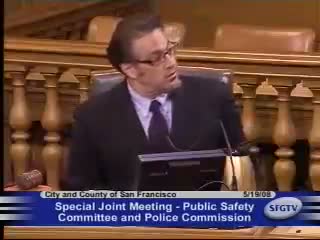
The presentation — delivered to a joint meeting of the Board of Supervisors’ Public Safety Committee and the Police Commission — framed the change as a way to reallocate administrative staff, even out officer workload and modernize operations so patrol officers spend more time in neighborhoods rather than at station desks.
Kim Craven, principal for the Public Safety Strategies Group, said the eight‑month review drew on dozens of community meetings, surveys and an inventory of facilities. She cited two headline survey findings: “76% of the community members surveyed … believed that more officers were needed on the street,” and “86% of the department members of the San Francisco Police Department feel that more officers are needed on patrol.” Craven told the hearing the consultants found wide variation in officer workload — from roughly 450 to about 1,100 calls per officer per year — and “facility conditions” at several district stations that make normal police work difficult.
The consultants’ recommended model would flatten geographic and staffing disparities across districts, consolidate administrative functions, and reuse existing facilities where feasible. Craven urged a fiscally conservative approach: rather than rebuilding two separate stations in the Northeast, consolidate capital outlays into one replacement and retrofit other owned stations for expanded use. She cited planning figures presented in the hearing: a $20 million estimate for the Mission Bay (Southern) relocation and about $33 million to replace the Central station, and an operating‑lease example of roughly $10 million over five years for tactical and narcotics space that could be redirected to owned facilities.
On personnel structure, PSSG recommended aiming for a minimum 1:7 supervisor‑to‑officer span of control in patrol and moving many administrative desk duties to civilian staff so more sworn officers can be assigned to sectors. Craven said some functions now duplicated across 10 stations could be centralized, allowing officers to be redeployed to visible patrols.
City leaders and the police chief welcomed the study as rigorous but flagged implementation challenges. Police Chief Fong, a member of the steering committee, said the report “has a number of very valid points” but stressed that any boundary change requires careful coordination of management structure, technology systems (records, dispatch integration) and capital planning before relocations occur. She urged testing different district counts (five, six or seven) and refining command staffing models so that operational continuity and community access are preserved.
Supervisors and commissioners repeatedly raised two overarching concerns: how to preserve community policing connections if neighborhood stations are combined, and whether the plan adequately reached limited‑English and immigrant residents. Commissioner Lee and others emphasized that residents often equate community policing with the visible neighborhood captain and asked how the plan will ensure services for communities that are less likely to attend meetings or respond to surveys.
Craven and controller staff said they had conducted bilingual outreach and telephone oversampling to capture people who do not attend hearings, and they recommended phased pilots and a year of education if boundary changes move forward. Craven told the board, “we hope that through tonight’s discussion, we’ll be able to get to a point of commonality,” adding that the process would not be immediate and would require substantial community engagement and technology upgrades.
Public comment reflected the split in sentiment. Speakers from neighborhoods including the Tenderloin, Ingleside, Visitation Valley and Union Square voiced fears that closing or downsizing stations would lengthen response times, reduce local trust and eliminate long‑standing community ties to local captains and sergeants. Others supported the focus on modernizing technology and redeploying officers into patrols.
Next steps identified at the hearing included the controller’s office circulating capital‑planning dates and milestone memos to link the study to existing planning and budget timelines, and the police department and commission pledging more public briefings to explain options before any formal policy or ballot action. No formal decisions or votes were taken at the meeting.
The hearing made clear the consultants’ recommendation is a starting point for a multi‑year conversation: the city must resolve technical, equity and political questions before any station consolidation or boundary change is implemented.