Get Full Government Meeting Transcripts, Videos, & Alerts Forever!
Get email alerts on the Accountability topic
No spam. Unsubscribe anytime.
Police Department and Commission adopt new process to notify claimants, commission adds chief-review requirement
Summary
After extensive debate over the Marconi settlement and whether the department should investigate civil claims that do not result in OCC complaints, the commission adopted amended departmental procedures that require outreach to claimants and direct the chief to conduct a preliminary assessment when a claimant declines OCC review.
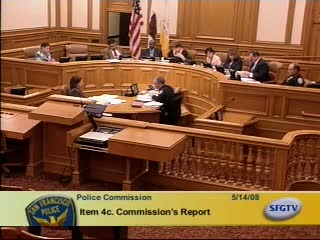
The San Francisco Police Commission on May 8 approved a package of departmental procedures intended to ensure civil claims and lawsuits alleging police misconduct are captured and reviewed by the department and the Office of Citizen Complaints (OCC). The proposed procedures task the department with assigning a litigation control number, mailing a notification letter (with OCC brochures in English, Spanish and Chinese), and following up by telephone. If the claimant does not receive the mailing, the department will attempt to re-contact and re-mail within specified windows.
The item sparked lengthy debate focused on the Marconi settlement, in which commissioners said serious allegations in a filed lawsuit had not prompted a timely internal review. Commissioner Petra de Jesus urged stronger obligations so that "egregious" allegations in lawsuits trigger department scrutiny even when claimants decline OCC investigations. Director Hicks and department counsel described resource and confidentiality concerns about automatically converting civil filings into OCC investigations.
The commission resolved the impasse by adopting the procedures with two amendments: (1) insertion of a clarifying sentence in the draft notification letter explaining that filing a citizen's complaint with the OCC is a process distinct from filing a civil suit, and (2) an explicit policy statement that the chief shall undertake a preliminary assessment when a civil complainant chooses not to file with the OCC, to determine whether a full internal investigation is warranted. The motion to approve the amended procedures carried by roll call.
The adopted process emphasizes notification and referral to OCC while placing the commission'level policy directive on the chief to review potentially serious allegations that would otherwise receive no OCC complaint. The department and OCC will track outcomes and report to the commission under existing oversight channels.