Get Full Government Meeting Transcripts, Videos, & Alerts Forever!
Get email alerts on the Public Safety topic
No spam. Unsubscribe anytime.
SFPD outlines working-group plan and data tracking to expand foot patrols
Summary
Commander John Murphy presented a draft implementation plan for foot-patrols based on the PSSG report, proposing working groups at stations, changes to training and policy (rewrite of general order 0602), and HMRS data tracking; commissioners requested timelines, exception reporting and community input.
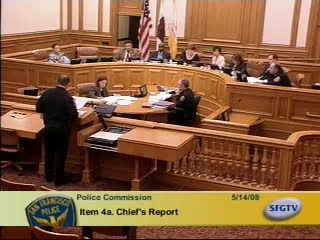
Commander John Murphy told the San Francisco Police Commission on May 8 that the department is developing a written implementation plan to translate the PSSG foot-patrol recommendations into operational practice. Murphy summarized a six-part framework—planning, data and documentation, policy and administration, training, community engagement and evaluation—and said the department expects to provide a draft plan to the commission by June.
Murphy described concrete changes under consideration: a rewrite of general order 0602 to standardize beat officer selection and supervision, an HMRS-based daily activity tracking mechanism (to log community meetings, permit checks and hours on foot beats), and a station-level working-group approach to define beat locations and schedules with community input. He said training would be standardized so officers across different neighborhoods receive equivalent preparation for local issues.
Commissioners pressed for implementation milestones, accountability and exception reporting. Commissioner David Campos asked when the commission would receive the written plan; Murphy said a draft would be provided by June and that the last box of the plan addresses "By when?" for implementation steps. Commissioners asked that the draft include explicit timelines, assignment of responsibility, and a mechanism to document when beats are not staffed. Murphy and department leaders said implementation will balance lessons from multiple studies and be flexible to integrate further consultant recommendations.
Murphy also noted operational details: initial focus on high-need Muni lines (54 and 9 and the 14 corridor), coordinating with school resource officers and other city agencies, and a goal of using data to compare pilot outcomes and replicate best practices. The commission placed the item as a tentative return for a future agenda to track progress.