Get Full Government Meeting Transcripts, Videos, & Alerts Forever!
Get email alerts on the Foot Patrol Evaluation topic
No spam. Unsubscribe anytime.
San Francisco reviewers praise foot-patrol pilot but urge clearer goals, better data and training
Summary
A joint Public Safety Committee and Police Commission hearing on the controller—s evaluation found strong public and officer backing for foot patrols but identified mapping, reporting and technology gaps; the SFPD committed to a near-term implementation plan and periodic reporting to the commission.
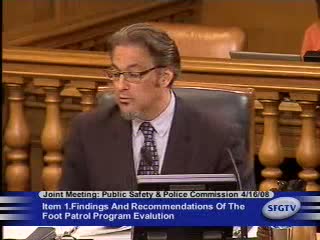
A joint hearing of the San Francisco Board of Supervisors— Public Safety Committee and the San Francisco Police Commission reviewed the controller—s evaluation of a six‑month foot‑patrol pilot and recommended immediate operational reforms and clearer performance measures.
The report, prepared by Public Safety Strategies Group for the controller—s office, found that the program led to an 86% increase in foot‑patrol staffing during the pilot and that eight of 10 police districts met or exceeded 95% of the staffing target. Community support for the initiative ranged from roughly 73% to 90% across different survey modes; about three‑quarters of responding SFPD members said they supported the program.
Consultant Kim Craven, who presented the findings, said the study relied on millions of CAD call‑for‑service records, incident reports and personnel records, plus interviews, three public hearings, roughly 45 community meetings, three focus groups and two surveys that together drew about 2,100 community responses. "This is the most comprehensive study that's been done on a police department with foot patrols," she told supervisors and commissioners.
But the evaluation also flagged significant implementation challenges. Analysts said the department—s legacy information systems and inconsistent beat coding in CAD and incident files made it hard to track when and where individual beats operated. Consultants also found weak standardization of district reporting and the absence of clearly documented, measurable goals and operational objectives for beat officers.
To address those gaps, the report recommended that the city and SFPD: define the program—s primary purpose (community engagement, crime reduction or a combination), create a standing working group—facilitated by an impartial outside expert with SFPD participation—to set goals and timelines, standardize beat mapping and reporting formats, integrate beat maps into CAD, and update training and job descriptions for beat officers and supervising commanders.
Chief Heather Fong told the hearing the department accepts the findings and will work to implement recommendations. She acknowledged technology constraints but said the command staff has begun drafting implementation steps and would bring a detailed response and timeline back to the commission and the board. "We're committed to it," she said, and signaled an expected follow‑up to the commission in roughly four weeks to outline deliverables and reporting templates.
Supervisors pressed for concrete success metrics and baseline data so the city can measure crime and community outcomes over time. Consultants cautioned against treating a six‑month pilot as sufficient to detect long‑term crime trends and recommended ongoing, standardized data collection to permit year‑over‑year comparison.
The hearing also produced several operational commitments: SFPD said it would produce standardized captain reporting templates, consider formal job descriptions and time commitments for beat officers so communities can expect continuity, and propose interim steps to capture and deliver data while the department transitions to a new records management system.
The board and commission said they will continue oversight as related studies (district station boundaries and a police‑effectiveness review) are completed and urged quick adoption of the low‑cost, high‑impact recommendations. The consultants left the city electronic staffing summaries, maps and a cleaned dataset to support future tracking and analysis. The next related public meeting on district boundaries was scheduled for May 19.