Get Full Government Meeting Transcripts, Videos, & Alerts Forever!
Get email alerts on the Juvenile Detention Dgo topic
No spam. Unsubscribe anytime.
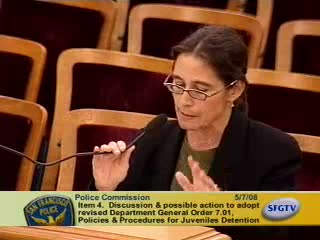
Police Commission adopts revised juvenile-detention policy, strengthens Miranda and parental-notification rules
Summary
The San Francisco Police Commission on May 7 adopted a revised Department General Order 7.01 that adds age-appropriate Miranda admonitions, expands parental-notification rights and limits custodial-interrogation procedures for juveniles; the vote passed without objection after broad stakeholder support.
The San Francisco Police Commission adopted a revised Department General Order (DGO) 7.01 on May 7, 2008, adding new protections for youth taken into police custody and clarifying notification and interrogation practices.
The commission voted to revise and adopt the juvenile-detention order after presentations from the Office of Citizen Complaints (OCC), the police department and a coalition of juvenile-justice advocates. The adopted changes require Miranda admonitions to be given in language appropriate to a young person’s age and sophistication, expand parental notification when juveniles are detained or moved by officers, and set new limits on custodial interrogation (including a two-person interrogator limit and audio recording of interrogations in most cases).
Sam Ramarian, staff attorney with the OCC, summarized the major provisions: "Under the new provisions, Miranda warnings will be provided in the language appropriate for the age and sophistication of the youth," and the DGO "permits parents and guardians to talk to their children before custodial interrogation," with limited exceptions. Lieutenant Valerie Agard, head of Juvenile Services, told the commission the order meets correctional standards and is intended to prioritize alternatives to bringing youth to district stations.
Community groups, the juvenile-probation chief and the youth commission urged adoption. Patricia Lee of a juvenile-defense organization called audio-recording of interrogations and parental presence "critical" and said the provisions reflect legal precedent recognizing developmental differences between minors and adults.
Several commissioners sought clarifications on parental notification timing and language access. The city attorney’s office proposed uniform wording to ensure DGO 7.01 cross-references the department’s language-access DGO and existing immigration-related DGOs. Commissioners agreed to minor clarifying amendments requiring parental-notification steps be taken in accordance with the DGO’s Section G and to reference General Order 5.2 for language-access practice.
The motion to revise and adopt DGO 7.01 was moved, seconded and approved without objection. The commission directed the department and OCC to proceed with training, translated public materials and implementation steps so the protections could be operationalized in roll-call and field training.
The commission noted a follow-up: members suggested a future joint meeting with the Youth Commission to review implementation and community outreach.