Get Full Government Meeting Transcripts, Videos, & Alerts Forever!
Get email alerts on the Disciplinary Procedure topic
No spam. Unsubscribe anytime.
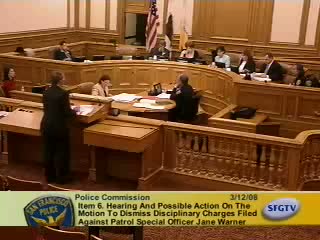
Commission hears heated arguments over motion to dismiss charges for patrol special officer
Summary
The commission heard oral argument on a motion to dismiss disciplinary charges against patrol special officer Jane Warner, centering on whether departmental general orders incorporate police‑officer protections (POBR); commissioners requested narrow supplemental briefing and continued the matter to a later date.
The Police Commission heard competing legal arguments on March 12 over a motion to dismiss disciplinary charges filed against Patrol Special Officer Jane Warner (file C07‑039). The hearing focused on whether provisions drawn from the police officer bill of rights (POBR) — specifically Department General Order 2.08 and related policies — are incorporated into rules that govern patrol special officers and therefore whether Warner was deprived of constitutionally adequate procedural protections.
Counsel for Jane Warner argued the department did not advise Warner of an investigation before questioning her and said general orders that incorporate POBR protections have been applied to patrol specials; counsel urged dismissal on due‑process grounds given what they described as a tainted process and the property interest Warner holds in her patrol assignment (a transferable “beat”). “We respectfully request that this matter be dismissed,” counsel told the commission, asserting that procedural defects surrounding a pre‑charge interview and notice went to the heart of Warner’s property and employment interests.
Department counsel Ashley Worsham replied that Warner is not a peace officer as defined by the Penal Code and that the rules and procedures governing patrol special officers specifically state they are not members of the uniform ranks and do not confer peace‑officer status. Worsham said Warner received written notice of charges, was provided the department’s discovery file on two occasions, has counsel, and retains the right to present witnesses and cross‑examine adverse witnesses at the upcoming commission hearing. “She has been provided with notice of the intended charges,” Worsham said, and the department asked the commission to deny the motion to dismiss.
Commissioners posed detailed legal and factual questions about what constitutes an “interrogation,” whether particular general orders apply to patrol specials, and what the appropriate remedy would be if a procedural rule had been violated (suppression of a statement versus dismissal of charges). One line of questioning asked the department to identify which DGOs it deems applicable to patrol special officers and whether specific rules — for example, a section enumerating DGOs that apply to patrol specials (referred to in argument as rule 3.12/section on applicability) — abrogate the bootstrap argument.
After oral argument and extended questioning, the commission voted to take the matter under submission and requested narrow supplemental briefing focused on whether the department’s general orders and the cited rule(s) incorporate POBR protections for patrol special officers and, if so, what remedies would follow. The commission set deadlines and a continuation date: parties were asked to file supplemental briefs by March 28 and the matter was continued to the first April meeting (April 2) for further consideration and for calendaring the trial schedule.
No final ruling on the motion to dismiss was issued at the meeting; commissioners emphasized the legal complexity and the need for additional written briefing to decide whether procedural defects — if proven — require suppression or dismissal.