Get Full Government Meeting Transcripts, Videos, & Alerts Forever!
Get email alerts on the Public Safety Shotspotter topic
No spam. Unsubscribe anytime.
SFPD rolls out zone‑based violence plan, expands ShotSpotter pilot in Bayview
Summary
San Francisco Police Department presented a 2008 violence‑reduction plan that concentrates enforcement in five data‑driven zones and described a ShotSpotter gunshot‑detection pilot (26 sensors across ~1.3 sq. miles) in the Bayview, to be evaluated over 60 days with potential expansion to the Western Addition.
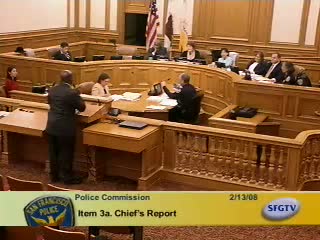
San Francisco Police Department leaders presented a new, enforcement‑focused violence reduction plan and an expanded pilot of a gunshot‑detection system at the Police Commission meeting on March 12, 2008. Chief Fong and acting deputy chief Leroy Cashman said the strategy concentrates existing resources in five data‑identified zones where roughly 45–50% of violent crime occurs in about 2% of the city's geography.
“We intend to use every tool in our toolbox,” Acting Deputy Chief Cashman said, describing a mix of target‑specific and zone‑specific deployments, buy‑bust operations, probation searches, stay‑away orders and intensified foot and traffic patrols. Cashman told commissioners the department identified 60 high‑risk offenders as part of the initial enforcement effort and said 15 of those were already in custody or pending felony cases.
Lieutenant Mikhail Ali described technical and operational details of the ShotSpotter pilot now active in the Bayview. He said the system covers approximately 1.3 square miles and uses 26 acoustic sensors there; activations are reported to staff within about 5–15 seconds (average ~10 seconds) and the vendor guarantees accuracy within 25 meters, although the department has found activations often within a few feet of incidents. The Mayor's Office of Criminal Justice funded the current deployment, and Ali said the city is treating the installation as a pilot to be evaluated over a 60‑day period.
Ali said the department has already used the system to locate casings and corroborate scene evidence in recent activations. “In that situation, that is helpful because we can review the footage, and it can be helpful in an investigation,” he said, noting that ShotSpotter activations have supplemented community‑generated 911 calls. The department plans to add workstations at Bayview Station, integrate alerts into dispatch and place monitors in patrol supervisor cars within weeks.
Cashman framed ShotSpotter as one element in a larger violence reduction strategy that includes coordination with probation, federal partners and community‑based organizations. He described five enforcement zones — including the Tenderloin/South of Market, Western Addition, Mission, Bayview subzones (Potrero Hill, Hunters View, Alice Griffith) and Visitation Valley — and said resources will be scheduled weekly and adjusted in real time when incidents occur.
Cashman also described complementary tactics: buy‑bust operations that reduce drug sales and can produce sentencing enhancements; focused probation (10.35) searches of high‑risk offenders; stay‑away orders enforced in coordination with the district attorney; and a Market Street patrol program and targeted motorcycle traffic squads to increase visibility.
The department said recent indicators are cautiously optimistic: in the weeks after the pilot deployment the city recorded fewer homicides in the targeted zones compared with previous periods, and it reported jail population and clearance statistics it will continue to monitor. Cashman cautioned the commission that long‑term effects will depend on continued interagency coordination and community cooperation. “This is 100% about rehabilitation,” Cashman said, adding that enforcement is designed to be paired with interventions.
Commissioners asked for data on how many arrests and clearances resulted from the new deployments; Cashman said he could provide more detailed statistics and that UC Berkeley will soon present an independent assessment of the city's surveillance camera program, while MOCJ will undertake cost and efficacy reviews of other elements. Several commissioners expressed support for combining technologies — for example, using ShotSpotter to cue cameras — but said they also want clarity on privacy and applicability of particular general orders to new operations.
The commission did not take policy action on the plan at the meeting; commissioners requested follow‑up data and promised public briefings so neighborhoods in the affected zones could review the strategy and its evaluation.