Get Full Government Meeting Transcripts, Videos, & Alerts Forever!
Get email alerts on the Police Budget topic
No spam. Unsubscribe anytime.
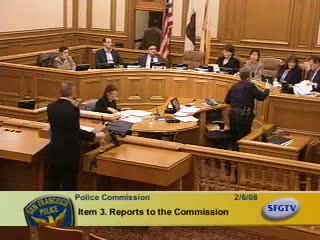
SFPD outlines $37 million ask to cover staffing, overtime and facilities in 2008-09 budget
Summary
City budget staff told the Police Commission the departments preliminary FY2008-09 submission asks roughly $37 million above base for sworn staffing, five academy classes, overtime, facilities leases and IT upgrades; commissioners asked for scenario analyses including DROP pension effects and prioritized measures to reduce homicides.
San Francisco Department budget staff presented a preliminary FY2008-09 plan to the Police Commission on Thursday that proposes roughly $37 million in additional general-fund support above a $432 million base to cover staffing, facilities and equipment needs.
Lede facts: Director Bukowski said the proposed increases reflect a mix of sworn salary costs, five planned academy classes (about 250 recruits, $8.6 million), structural corrections to premium/holiday pay ($3.6 million), and an increase in overtime funding (projected need of roughly $22 million, an increase of about $7.4 million). He also flagged facilities and lease pressures (a potential tactical unit lease and a $125,000 annual port site fee for EVOC training) and one-time equipment and IT needs including additional data storage and a forensic management system.
Why it matters: Commissioners said the budget must account for immediate operational priorities, especially homicide and violent-crime reduction, while remaining realistic about citywide constraints. The departments staffing and overtime choices shape response capacity and the viability of specialized units.
Key numbers and constraints: Bukowski said about 89% of the departments budget is salaries and fringe and that about $20 million of the proposed increase is sworn salary-related. An additional $4.7 million is shown for civilian positions (including civilianization of records and IT support), and equipment/IT requests total about $5.8 million (including $200k+ for RMS storage and $300k for initial forensic management work). He said the mayors 8% departmental reduction scenario would create a $46 million swing versus the departments submitted priorities.
DROP pension measure and workforce planning: Commissioners asked how a forthcoming DROP (deferred retirement option plan) measure could change separations and budget assumptions. Bukowski said an estimated 500 officers could be eligible but not all would participate; the city expects the measure to be cost neutral in planning, but commissioners asked for sliding-scale scenarios to understand the budgetary impact and staffing implications for specialized units.
Facilities and training sites: The department outlined a range of facility repair needs and a possible tactical-unit relocation with an annual lease cost estimate of $1.3 million. The department also uses port property for EVOC training; the ports anticipated $125,000 annual charge prompted commissioners to ask whether the department could negotiate different arrangements or offset port charges with reimbursable services.
Crime-reduction tie-ins: Commissioners pressed Bukowski and Police command staff for clarity on how the budget steers resources directly to homicide and violence-reduction strategies. Chief and command staff described a command-level strategic planning retreat with PERF and an intent to deploy multi-pronged strategies and data measures (CompStat-like tracking) to measure impact. Commissioners asked for an explicit statement of how proposed staffing and overtime changes would be directed toward violent-crime reduction.
Next steps: Bukowski will return with more detailed Form 7 submissions and scenarios, and the commission asked for a follow-up briefing that compares worst-case and best-case budget scenarios for academy classes, DROP participation, and overtime prioritization.