Get Full Government Meeting Transcripts, Videos, & Alerts Forever!
Get email alerts on the Civil Gang Injunctions topic
No spam. Unsubscribe anytime.
City attorney, public defender and SFPD debate criteria and opt-out for civil gang injunctions
Summary
At a Police Commission hearing, SFPD officers described the multi-agency process for recommending individuals for civil gang injunctions; the City Attorney defended individualized, evidence-heavy filings while the Public Defender cited cases of stale or mistaken inclusions and urged a formal opt-out process and better monitoring of outcomes.
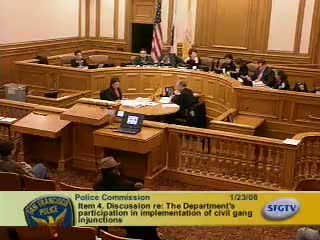
The Police Commission on Jan. 23 heard an extended discussion of how the San Francisco Police Department participates in civil gang injunctions — a court-ordered tool that restricts activities of named individuals within defined “safety zones.”
Lieutenant Ernie Ferando and other SFPD gang experts described a validation process based on a multi-factor checklist used by gang investigators; they said their role is to compile boxes of documentation — incident reports, field interview (FI) cards, photographs, graffiti mapping and other materials — and to forward candidate names to the City Attorney’s Office for legal review. Ferando said SFPD had three injunction geographic filings at the time: two permanent injunctions (Bayview/Oakdale and Western Addition) and one preliminary injunction (Mission). He gave working counts of roughly 23 names for Oakdale, 30 for Western Addition and 43 associated with the Mission filing.
Deputy City Attorney Alex Yee and City Attorney Dennis Herrera described the City Attorney’s role as an independent, manual and redaction-aware review of the evidence. Yee said attorneys evaluate whether the provided materials meet the court’s clear-and-convincing evidence standard before signing pleadings. Herrera said the office favored naming individuals rather than broad gang labels and that each listed person required individualized justification.
Public Defender Jeff Adachi told the commission his office had documented cases where individuals named on injunction filings lacked convictions, had stale information used against them, or suffered harmful public exposure. Adachi described his office’s difficulty intervening in civil proceedings when individuals lack resources and advocated for a transparent, accessible opt-out mechanism modeled after procedures in other jurisdictions such as Los Angeles.
Commissioners and presenters agreed on several process improvements to explore: better public-facing information about criteria and opt-out paths, improved monitoring of neighborhood crime statistics to measure injunction impact and enhanced collaboration between SFPD, the City Attorney and community-based intervention services. The City Attorney said preliminary data from at least one injunction area showed declines in violent crimes, and the office and SFPD affirmed they would continue to refine training, redaction practices and outreach.
The commission did not set new policy during the hearing but asked staff to return with more information, including clearer metrics on outcomes and proposals for opt-out and monitoring procedures.