Get Full Government Meeting Transcripts, Videos, & Alerts Forever!
Get email alerts on the Surveillance Cameras topic
No spam. Unsubscribe anytime.
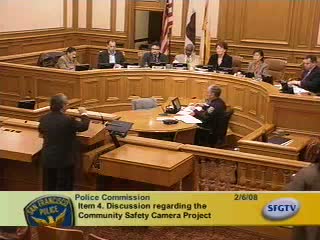
Police commission presses city on camera performance after Chronicle footage leak
Summary
The San Francisco Police Commission questioned city officials on Tuesday about technical limits of a 74-camera pilot and safeguards after footage appeared in the Chronicle. City staff said a UC Berkeley study due March 20 will measure efficacy; commissioners pressed for audits, protective orders, and a process to pause cameras during permitted demonstrations.
San Francisco The Police Commission pressed city officials on Thursday over the performance and handling of the citys community safety camera pilot after a San Francisco Chronicle story published camera footage.
City Administrator Ed Lee told the commission the program includes 74 cameras at about 25 locations and that the city contracted with UC Berkeleys research team (referred to in testimony as "Citrus") to evaluate whether the system is effective. He said the research teams preliminary report is expected March 20 and that he had asked the Board of Supervisors to amend reporting timelines so the evaluation could cover a full year of data.
Why it matters: Commissioners said the cameras were approved as a limited pilot with explicit privacy safeguards and conditions — including a requirement that footage generally be released only under court order — and they want prompt answers about why footage appeared in the Chronicle. Several commissioners said technical limits and the possible unauthorized release undercut the publics confidence in the project.
What officials said: Richard Robinson, chief operations officer for the Department of Technology and Information Services (DTIS), described why some early installations performed poorly. "We initially put those on as a matter of expedience in public domain spectrum, Wi-Fi frequencies" and later moved affected links to a 4.9 GHz public-safety band, Robinson said, noting the cameras are capable of higher frame rates but that storage and bandwidth limits required dialing recording settings down. Robinson said the city could run cameras at "12 to 15 frames per second" if it tied cameras to fiber and increased storage.
On the question of disclosure, Lee told commissioners the ordinance requires formal steps and, typically, disclosure of footage outside the criminal investigation chain occurs only with a court order. He said staff had not yet been able to confirm how the Chronicle obtained the footage and that he had asked the mayors office and supervisors to clarify the annual reporting language to avoid future timing confusion.
Evidence and use: Police officials said the department has pulled footage 78 times for investigations and that in two instances footage directly aided prosecutions (one homicide and one gang task force case). SFPD representatives also told the commission that while many pulls yielded images that were not fully usable because of focus or frame-rate limits, footage nonetheless reduced investigative hours by narrowing suspect descriptions and directing field work.
Commission response and requested steps: Commissioners pressed city staff to: 1) audit cameras to verify frame rate and resolution before the UC Berkeley analysis; 2) implement a formal feedback loop so end users (police, district attorney) can report footage quality; 3) strengthen procedural safeguards, including protective orders when footage is released in discovery; and 4) adopt a process to ensure cameras are turned off or re-angled for permitted First Amendment events when advance notice is provided. Judge Ryan (appearing as a city legal participant) urged folding camera disclosure into criminal discovery procedures and using protective orders to prevent wider dissemination.
Public reaction at the meeting: Several neighborhood leaders told the commission cameras have had a deterrent effect in high-crime blocks and urged the commission to wait for the March evaluation before making policy changes. At least one neighborhood representative asked the commission to investigate who provided footage to the Chronicle.
Next steps: The commission asked staff to pursue near-term administrative safeguards (protective-order practices in discovery and clearer operational procedures for permitted demonstrations) and to return with technical audit results and the UC Berkeley preliminary report on March 20. The commission indicated it may place a formal action item on a future agenda if the March report or follow-up audits raise additional concerns.