Get Full Government Meeting Transcripts, Videos, & Alerts Forever!
Get email alerts on the Community Policing topic
No spam. Unsubscribe anytime.
Park Station captain credits beats, outreach and targeted injunctions for drop in crime; public raises concerns about patrol specials and homelessness citations
Summary
Captain John Ehrlich described lower Part 1 crime in the Park District and credited beat officers, early-morning park sweeps, collaboration and targeted gang injunctions for improvements. Public commenters praised the captain but raised concerns about private 'patrol specials' impersonating police and the effects of homelessness citations.
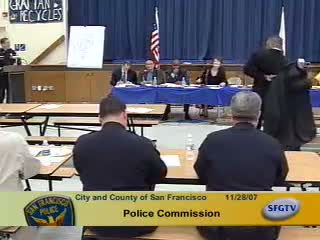
Captain John Ehrlich told the Police Commission meeting at Park Station that crime in the Park District has fallen amid a package of targeted enforcement, outreach and community engagement.
"Crime is down," Ehrlich told commissioners and residents. He described three key themes for the district: targeted response and enforcement, collaboration with a wide range of agencies and people, and building communities. The captain said his station deployed beat officers incrementally ("we started with 1... then 2, then 4") and runs early-morning sweeps in Golden Gate Park and other parks to discourage camping that damages park resources. He reported 23 citations recently issued for camping in Buena Vista Park.
Ehrlich credited collaborative forums such as the Albert Lake Forum for bringing service providers and residents together and said coordination with juvenile probation and other city agencies helped reduce youth involvement in violence. He pointed to a prior peak in homicides in 2005 — "we had 7 homicides in the Park District. 6 of those were gang related" — and said beats and strategic deployments helped suppress violence in hotspots.
Community responses were largely positive: several residents from King/Marcus Garvey and the Western Addition praised Captain Ehrlich and patrol officers for outreach and foot patrols that helped restore neighborhood confidence. David Crony of the Coal Valley Improvement Association said a formerly frequent stream of complaints had disappeared under the current leadership.
At the same time, two recurring concerns surfaced in public comment. Alan White warned that privately contracted "patrol specials" are behaving like police officers and described incidents where individuals were removed from homes without due process, calling it "an erosion of trust." Jonathan Rogers and other residents described hotel managers relying on patrol specials rather than officers, resulting in evictions and confusion over who enforces tenant rights.
Ehrlich said enforcement targets behavior and community impact, not homelessness itself. "We don't target homeless," he said in response to questions, explaining that officers focus on quality-of-life disturbances and the spirit of the law, while outreach officers and partners try to provide resources and alternatives.
Why it matters: The Park Station account offers a case study in neighborhood-specific approaches — beat assignments, partnership forums and selective enforcement — described by the captain and commended by local leaders. It also surfaces unresolved oversight questions about private patrols and how hotel-based security interacts with SFPD response and tenant protections.
Ending: Commissioners encouraged documentation of successful tactics so other districts can adapt them; they also asked for further city-level discussion on homelessness and the role of other agencies and services.