Get Full Government Meeting Transcripts, Videos, & Alerts Forever!
Get email alerts on the SRO Training topic
No spam. Unsubscribe anytime.
Police academy expands SRO and landlord-tenant training with tenant groups
Summary
SFPD presented enhancements to academy training on SRO (single-room-occupancy) and landlord-tenant disputes, including roll-call lesson plans, role-playing, and partnerships with tenant groups; commissioners and community representatives urged strong language access and cultural-competency elements.
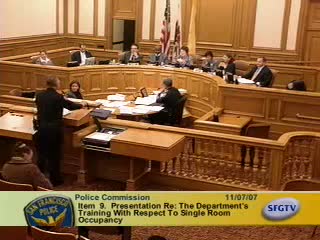
The Police Commission received a presentation Nov. 7 on additions to the police academy curriculum designed to improve responses to single-room-occupancy (SRO) disputes and landlord-tenant conflicts.
Captain Richard Curry and Officer Nate Stager said the academy has developed two roll-call lesson plans (visitor policy and lockouts/tenancy rights) and is adding SRO-specific lecture material to the basic recruit curriculum. Training emphasizes conflict-resolution skills, role-playing scenarios, referral resources (Rent Board, tenants unions), and cultural competency by involving tenant-community representatives in classroom sessions and role-playing.
Officer Stager described methods used in the class — discussion, role play, handouts and quizzes — and said recruits— lived experience (many are tenants) is incorporated into exercises. "Our final objective is really to develop well informed, unbiased, and ultimately effective officers," he said.
Commissioners and community members commended the approach and asked that language-access requirements (new general order on language access), immigration-related concerns, and tenant outreach be integrated explicitly. Captain Curry said the working group will meet Dec. 4 to refine deliverables and that community groups will participate in scenario development and cultural-competency sessions.
Commissioners asked the department to continue periodic updates and to expand outreach so tenants and owners also understand rights and remedies, reducing the information asymmetry the department sometimes witnesses when it responds to disputes.