Get Full Government Meeting Transcripts, Videos, & Alerts Forever!
Get email alerts on the Patrol Specials topic
No spam. Unsubscribe anytime.
San Francisco Police Commission weighs overhaul of Patrol Specials after months-long backlog and wide public support
Summary
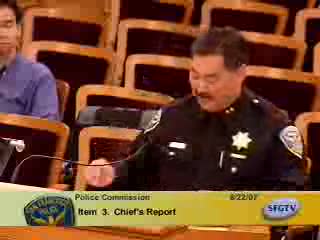
At its Aug. 22, 2007, meeting the San Francisco Police Commission heard a department update and extensive public testimony about the city's Patrol Specials program, directing staff and the city attorney to draft new rules and to provide monthly status reports on background processing and beat transfers.
The San Francisco Police Commission on Aug. 22 heard an extended item on the city's Patrol Specials program, with the police department reporting application and background-check backlogs and residents, merchants and patrol-special officers urging clearer rules, better training and, in some cases, increased operational authority.
The chief told the commission the department received 11 applications for assistant Patrol Specials in February 2007, with 7 in the background process and 4 completed; of the completed applications, 2 were denied for not meeting minimum standards and 2 were undergoing review. The chief said background investigations can take "on average between 6 and 8 months," and described delays caused by missing paperwork, waiver forms and live-scan fingerprint processing by the Department of Justice.
That update prompted lengthy questioning from commissioners about priorities, whether outside background providers are certified, and why the department reviews outside agencies' work rather than performing all checks internally. Commissioners pressed the department to improve applicant notification and to train specific officers to handle patrol-special backgrounds to expedite the process.
Public testimony was heavily in favor of the Patrol Specials program but urged fixes. Jane Warner, president of the Patrol Special association, described decades of community-policing work and urged the commission to include patrol-special representatives "when you rewrite our rules and procedures." Warner said the organization needs practical tools to be effective: "I would like to have the ability to write a police report," she told the commission, and also asked for ticket books and clearer, consistent training and supervision across districts.
Business and neighborhood voices endorsed the program's impact on street safety. Eric Abuego, a Mission merchant, said the presence of Patrol Specials helped reduce loitering and violent incidents on 20th Street and that "they are very courteous; never heard any complaints from the merchants or the residents." Ron Lee and others offered similar praise for patrol-special officers in Diamond Heights and the Castro.
Speakers also raised operational and administrative problems: long delays in processing applications, unclear lines about who approves beat transfers, inconsistent enforcement of Department General Orders across stations, and a slate of "abandoned" beats—geographic beat assignments held by owners who do not actively patrol—that frustrate active operators. A long-time beat owner recommended expanding or realigning beats to make them viable.
Legal and procedural questions came up repeatedly. Commissioners and the deputy city attorney noted that the commission has delegated day-to-day administration of the Patrol Specials program to the chief by rule, but that beat ownership and transfers are subject to commission approval. The deputy city attorney said there may be state-law distinctions that apply to some assistant positions. Commissioner Veronese volunteered to draft a resolution with the city attorney to create an interim appeals process so Patrol Specials can seek direct commission review when administrative disputes arise.
The commission directed Commissioner Lee to work with the city attorney on drafting revised rules and asked the chief to provide monthly status reports on backgrounds, hiring a background investigator, and other process improvements. The chief said she will remain available to answer follow-up questions.
Formal business at the meeting included approval of a small donation to the SFPD canine unit and routine minutes; the commission later voted "no disclosure" on its closed-session discussions and adjourned shortly after 8:15 p.m.
What happens next: commissioners said they expect to receive draft regulations and to consider an appeals process for patrol-special disputes; the chief will supply monthly progress reports on the background and beat-transfer backlog.