Get Full Government Meeting Transcripts, Videos, & Alerts Forever!
Get email alerts on the Medical Cannabis Policy topic
No spam. Unsubscribe anytime.
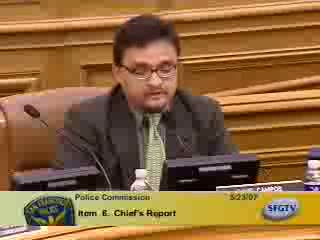
SFPD briefs commission on medical cannabis permitting, pledges clearer process and outreach
Summary
Deputy Chief Morris Tabak and narcotics lieutenant Rick Perry told the commission the SFPD is working with patient advocates and supervisors to remove department barriers in the medical cannabis permitting process, and emphasized that compliant patients and collectives "have nothing to fear" from enforcement. Community advocates urged protections for cultivation sites and a mutually agreed liaison.
Deputy Chief Morris Tabak told the San Francisco Police Commission the department has been working for weeks with patient advocates and supervisor offices to resolve conflicts in the medical cannabis permitting process and to clarify SFPD'roles.
Tabak outlined three areas the department handles: compassionate-use cases, criminal activity associated with marijuana, and for-profit marijuana operations. He said statutory authorities such as Proposition 215 (Compassionate Use Act of 1996) and Health & Safety Code section 11362.5 as well as Senate Bill 420 shape the landscape and that some local ordinance language and the department's access to criminal-data systems (CLETS) created legal conflicts with the permitting process. Tabak said proposed legislative language from Supervisor Michela Alioto-Pier, submitted with concurrence from Supervisor Ross Mirkarimi's office, aims to remove SFPD from certain permitting duties by inserting other city agencies (for example, Department of Building Inspection and the Fire Department) to perform required security and fire inspections, while Department of Justice'approved vendors could handle background checks.
"Patients, caregivers, and dispensaries who operate within the rules set forth in the legislation ' have nothing to fear from the San Francisco Police Department," Tabak said, according to meeting remarks.
Lieutenant Rick Perry of the narcotics division broke enforcement work into three types: compassionate-use investigations (where officers ask whether detainees possess medical cannabis cards or are primary caregivers and where the department said it "opts to on the side of the patient"), investigations where marijuana appears alongside other criminal activity (burglary, trafficking, or cultivation that creates fire hazards), and for-profit cultivation or trafficking pursued as criminal investigations. Perry described recent search-warrant operations that uncovered large-scale cultivation and firearms, noting these often involved no assertion of a medical-defense by those arrested.
Commissioners asked about training, cross-deputization, and how SFPD avoids perceptions of federal collaboration on medical cannabis enforcement. Tabak and Perry said the department does not participate with the DEA on medicinal marijuana cases, that cross-designations to federal task forces are case-specific and limited to the duration of particular investigations, and that the department has issued multiple bulletins and training supplements to guide officers.
Members of the public gave mixed testimony. Shona Gokner, representing patient-advocacy groups, said meetings with the chief and staff produced practical proposals: removing the police department from permitting inspections, inserting DBI for security-inspection roles, identifying and protecting compassionate cultivation sites, establishing a mutually agreed community liaison with disability-advocacy experience, and creating a cannabis unit within SFPD to resolve assignment conflicts. Dr. Maggie Rubinstein and other patient advocates thanked the department for continuing the working group and pressed for education and safeguards to prevent federal entanglements. A neighborhood speaker Fensio Salazar warned of criminal exploitation of the market and urged caution from the department.
Tabak said the legislative changes were expected to go to committee and possibly the full Board of Supervisors within roughly 30 days of the draft dated May 16; he reported the outreach and draft materials will be provided to commissioners in their packets.
The commission did not take a formal vote on an ordinance during the meeting but recorded agreement to continue the working group and follow up with the Board of Supervisors' process.