Get Full Government Meeting Transcripts, Videos, & Alerts Forever!
Get email alerts on the Police Oversight topic
No spam. Unsubscribe anytime.
Police oversight office defends investigating civil claim forms after POA objects; commissioners plan policy debate
Summary
Interim OCC Director Jean Field said the Office of Citizen Complaints is contacting claimants and allowing opt-outs after the department began forwarding government tort claims; the Police Officers Association urged the commission to halt OCC-initiated administrative complaints without claimant verification. Commissioners set a public agenda date for further discussion on June 23.
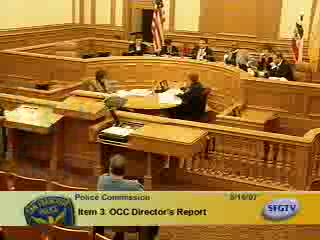
Interim Office of Citizen Complaints Director Jean Field told the San Francisco Police Commission that the OCC has begun receiving government tort claim forms from the police department and has updated procedures to investigate whether those pre-lawsuit claims raise administrative misconduct issues.
"We are getting all of them whether or not there has been an OCC complaint filed also separately," Field said, and described steps the office is taking to contact claimants by letter and telephone and to let complainants "opt out" of an OCC investigation when appropriate. She said the OCCwill report back with results of these cases in about two months.
The practice drew sharp criticism from Steve Johnson of the San Francisco Police Officers Association, who said the OCC was "simply file[ing] complaints against the police officers themselves" without contacting claimants and that doing so could put officers into early intervention review. "When I found out, I talked to Jean, the interim director," Johnson said. "If any of those complaints are ever withdrawn by a claimant ... we'll just make it a no finding. Well, that doesn't fix anything because a no finding means the complaint is still there against the police officer."
Field said the OCC has relied on a long-standing procedure dating to at least 1997 for opening files from claim forms and has modified, but not abandoned, that practice. She emphasized the OCCs intent to be fair to both claimants and officers, to gather information on outcomes, and to provide the chief with the administrative facts that could warrant disciplinary review.
Commissioners pressed for further dialogue and review. Vice President David Campos and others urged the OCC, the Police Officers Association and the police department to meet and attempt to resolve disputes before the commission takes formal action; several commissioners said the matter should be placed on a future agenda for public discussion. The commission agreed to keep June 23 open to receive a draft policy and directed the OCC to forward the policy to commissioners and to Sergeant Riley for review.
Field reported broader OCC performance numbers that provide context for the debate: the OCC's pending case list has fallen below 400; the office closed 26 of the oldest cases from 2004 and early 2005 and closed 123 cases from February 2006 in the first quarter. Field said about 28 percent of the cases closed were over nine months old, a statistic she and commissioners attributed to intentional prioritization of the oldest backlog.
Commissioners also raised budget and staffing questions. Field said conversations with the mayor's budget analysts were ongoing and that the additional funding the OCC requested was "less than a million," and that the office is continuing interim reforms while awaiting a permanent director.
The commission did not direct an immediate moratorium; instead members asked the parties to meet, requested that a draft policy be returned to the commission and set a date for the item to appear on the agenda. The June 23 session was identified as the likely public forum to consider a policy that would clarify how civil claim forms are handled and whether the OCC should automatically open administrative complaints based on those claims.