Get Full Government Meeting Transcripts, Videos, & Alerts Forever!
Get email alerts on the Police Accountability topic
No spam. Unsubscribe anytime.
Police commission demands outside analysis of traffic-stop data after reporting gaps
Summary
The San Francisco Police Commission pressed department leaders on missing traffic-stop reports and racial-profiling concerns, asked an outside analyst to review compiled data, and sought a timebound update after the department cited technical and staffing reasons for discrepancies.
The San Francisco Police Commission on Wednesday pressed police leaders to resolve gaps in traffic-stop data that critics say undermine oversight of racially biased policing.
Vice President David Campos and other commissioners pressed Chief Fong and senior staff after a newspaper article questioned whether the department had been consistently producing the monthly traffic-stop reports required by a prior commission resolution. Commissioners said the question went to the heart of public trust and the commission's ability to carry out its charter oversight.
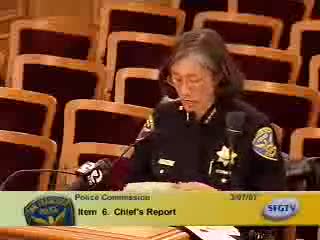
Chief Fong told the commission the department has continued collecting traffic-stop information and that the raw data compiled through February have been provided to an outside analyst, identified in the record as Dr. Fadell, for review. "All of the data that has been collected up until the end of the month of February has all been provided to Dr. Fadell, and she is analyzing that," he said. The chief also accepted responsibility for a lapse in presenting consistent written reports to the commission and proposed calendaring the information on a monthly or quarterly basis.
Department witnesses and a former commander described several technical and operational causes for discrepancies between the computer-assisted dispatch (CAD) logs and the traffic-stop template entries officers are required to complete: wireless transmission failures in parts of the city that can drop template submissions, entries recorded after midnight that appear on the next day's logs, backup officers recorded by CAD who did not complete separate templates, and solo motorcycle officers who rely on dispatchers to input data. "We think at that point some of those computer transmissions are lost," a department presenter said.
Commissioners repeatedly pressed for a clear, timebound deliverable. Campos warned that collecting data is not enough: the commission must see analyzed information and public reporting. He told the chief the public deserves assurance that the numbers reflect reality, saying the city must demonstrate it is "not going to tolerate racial profiling in the San Francisco Police Department." Chief Fong said the department has provided the material to Dr. Fadell and will seek to hire civilian analysts so sworn personnel are not tasked with statistical analysis.
The commission asked the chief to meet with Dr. Fadell and to report back to the body on a feasible timeline; the chief agreed to advise the commission after that meeting and the commissioners requested that, if possible, Dr. Fadell present results within three weeks. Commissioners also asked staff to assemble prior resolutions and reports related to the traffic-stop reporting requirement (discussed in the meeting as "Resolution 65-02") so the body can determine whether the reporting obligation contained a sunset clause and what form future monthly submissions should take.
The exchange included substantial public comment from advocates and former officials who said underreporting would compromise any effort to measure racial disparities in stops, searches and citations. One long-time advocate urged the commission to examine archived tapes and commission minutes from earlier years to confirm what the reporting practice had been.
The chief's team said it is working with radio/communications experts and technology vendors to fix dead spots and data transmission problems and that some reporting formats were changed after an analyst retired. The department also said it had applied for but did not receive a federal grant that would have funded multi-year analysis and audit support.
The commission said it will follow up with a request for an explicit timeline for the outside analysis, will seek copies of the historical reports provided by the department, and will consider revisions to the underlying resolution if the language is ambiguous about the reporting cadence or scope.
Next steps: the commission asked the department to provide a clear schedule for when members and the public can expect the external analyst's findings and for written monthly or quarterly reports to be placed on future agendas.