Get Full Government Meeting Transcripts, Videos, & Alerts Forever!
Get email alerts on the Public Safety Crime Trends topic
No spam. Unsubscribe anytime.
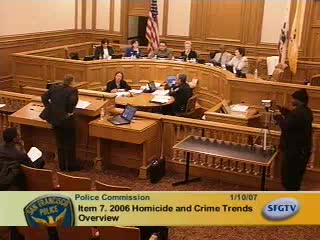
Police Commission hears 2006 crime‑trends briefing as department cites targeted enforcement and calls for broader criminal‑justice coordination
Summary
Deputy police officials told the San Francisco Police Commission that 2006 saw reductions in some homicide categories and a rise in certain crimes such as juvenile robberies and auto burglaries; presenters and commissioners pressed for more data on recidivism, out‑of‑county arrestees and court processing delays.
Deputy Chief (name as given in the presentation) told the San Francisco Police Commission that the department’s targeted enforcement strategy has contributed to reductions in city homicides and gang‑related violence while other crime categories showed mixed trends. “We probably prevented well close to 3 dozen homicides this year,” the deputy chief said during a detailed slide presentation on 2006 trends.
The presentation, introduced as Item 7 on the commission agenda, compared San Francisco’s felony admissions and strike populations with neighboring counties and identified three themes the department said affect violence: narcotics activity, recidivist offenders who repeatedly reoffend, and commuting offenders who come from outside the city. The deputy chief described the criminal‑justice system as a set of interlocking "spokes"—police, prosecutors, courts, probation—and urged coordinated action across that system.
Lieutenants who run specialized units gave the commission operational detail. Lieutenant John Loftus, head of the robbery detail, said robberies rose modestly over three years but juvenile involvement jumped sharply: cases closed with juvenile arrests in robbery increased from 72 in 2004 to 164 last year, “that is a 130% increase over those 3 years,” he said. Loftus also reported a surge in thefts of small, high‑value portable electronics and said roughly 24% of arrestees who provided valid addresses lived outside San Francisco.
Lieutenants Leroy Lindo, Tom Buckley and Mike Beal reviewed trends in spontaneous violent crime, burglary/fencing and auto theft/auto burglary, respectively. Beal said auto thefts fell while auto burglaries rose, driven in part by visible valuables left in vehicles such as laptops and GPS units.
Commissioners pressed the department for follow‑up data. Vice President David Campos and other commissioners asked for clearance rates for homicides, empirical measures of recidivism, and the extent to which delayed court processing or light bail affected outcomes. The deputy chief and the chief said some of the data will be provided in subsequent audits and presentations and described ongoing daily operational coordination with the district attorney, probation and other partners.
Public commenters and at least one commissioner urged broader prevention approaches, including restorative or community‑based interventions, and asked the department to work with other city agencies to ensure budgets and performance measures align with cross‑agency violence‑reduction strategies.
The commission did not take a formal measure on criminal‑justice policy at this meeting. Commissioners requested additional data on homicide clearance rates, the composition of out‑of‑county arrestees, and recidivism metrics for future meetings; the department agreed to provide more detailed follow‑up and audit materials.
The commission continued the remainder of the calendar and adjourned at 10:18 p.m.