Get Full Government Meeting Transcripts, Videos, & Alerts Forever!
Get email alerts on the Early Intervention System topic
No spam. Unsubscribe anytime.
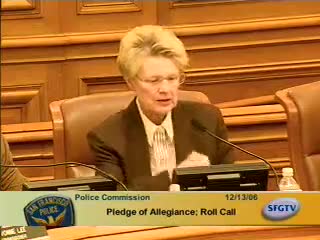
Police commission delays vote on Early Intervention System pending indicator, audit and outreach refinements
Summary
The commission heard a department presentation on draft General Order 3.19 (Early Intervention System), urged inclusion of community representation and audits, and agreed to return in January after the POA and other stakeholders resolve remaining indicator and language-access questions.
The San Francisco Police Commission on Wednesday received a discussion-only presentation of the department—s draft General Order 3.19, the agency's proposed Early Intervention System (EIS), and directed staff to return in January with unresolved language and indicator issues addressed.
Deputy Chief Kehane presented the draft and said the department has been negotiating language with the Police Officers Association and other stakeholders. "We have met with the POA, and they have come back with recommendations," he said, adding he believes the parties "are closer than ever" to an agreement and hopes the order can be adopted in January.
Commissioners focused on technical and governance details. Commissioner Yvonne Lee asked that the EIS board include an outside community expert to provide an independent viewpoint on cases and indicators; Deputy Chief Kehane said he would raise the suggestion in upcoming negotiations. Commissioner David Campos pressed for a clear timeline for the RFP tied to the EIS vendor: the department said bids are due Dec. 15 and that, depending on whether a turnkey vendor is selected or the system is integrated into the department—s records management system, rollout could begin in March with a department-wide deployment by June.
Members also pressed whether the system—s outputs would be public. Kehane said the department intends to publish aggregate data (for example, counts of incidents or accidents by station) but would not identify individual officers in those summaries. "If we put out the aggregate data that showed that one officer was involved in six accidents within a year, that officer wouldn't be readily identifiable," he said, "but it would show it has come to the attention of the department and whether action was taken."
Commissioner Petra de Jesus urged incorporating the American Civil Liberties Union's letter and ensuring audits are part of oversight. Kehane said audits are "an integral part" of the system but that early drafts kept audits in a separate operations manual to avoid having to repeatedly amend the general order; the department proposed notifying the commission when new audits are adopted.
The commission closed the public hearing after no speakers expressed comments on the EIS at the microphone and set an anticipated date in January for final action, with commissioners asking staff to resolve indicator definitions, language-access plans and the composition of the EIS board before returning.
The presentation was discussion-only; no formal vote on the EIS took place.
What happens next: staff and the POA will continue negotiations on indicator language and pursuit-counting methodology; the commission expects a follow-up meeting in January to consider adoption.