Get Full Government Meeting Transcripts, Videos, & Alerts Forever!
Get email alerts on the Police Discipline Transparency topic
No spam. Unsubscribe anytime.
Police commission delays decision on disclosure of officers' disciplinary settlements
Summary
After hours of testimony and debate over how to respond to the Copley decision, the San Francisco Police Commission voted to continue a proposed policy on public disclosure of stipulated disciplinary dispositions to Nov. 15 to allow more drafting and negotiation.
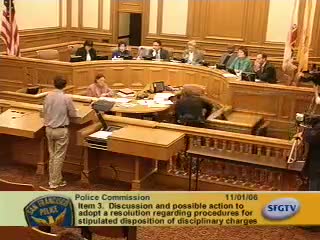
The San Francisco Police Commission on Nov. 1 delayed action on a proposed policy to increase public disclosure of stipulated disciplinary dispositions, voting to continue the matter until Nov. 15 after extended public testimony and a heated exchange among commissioners.
The debate centered on how to balance officer privacy under Penal Code section 832.7 and the public's interest in oversight following the recent Copley court decision. Mark Schlossberg, police-practices policy director for the ACLU of Northern California, told the commission it should publish as much information as the law permits and recommended categories of data — including case number, alleged violations, a brief factual summary, disposition, proceeding type and penalty — so "the public has a good idea about what type of disciplinary action is happening in the city and county of San Francisco."
Commissioner Joe Veronese introduced an amended policy statement that would require bimonthly reporting of privately held stipulated dispositions and encourage officers to waive confidentiality so matters could be handled publicly. Veronese said the amendment was a pragmatic first step after Copley and proposed a set of seven reporting points that would withhold officer identities while providing the public with greater information.
But several commissioners, including Vice President David Campos, said the amendment weakens the original resolution's intent to move stipulated dispositions into open session. Campos argued the commission should adopt the original resolution, which he said had been drafted with the city attorney and represented a conservative approach consistent with Copley.
Commissioner De Azuz criticized the late release of the amendment and described stipulated dispositions as a way for cases to be settled without the commission seeing evidence; she urged preserving transparency by requiring more open hearings. Other commissioners, including Theresa Sparks and Yvonne Lee, supported seeking a compromise that would increase public access to penalty decisions and policy failures while protecting legally required privacy.
After the debate the commission moved to continue the item to Nov. 15 to allow time to craft compromise language. The roll-call vote to continue carried: Aye — President Louise Rennie, Commissioner Yvonne Lee, Commissioner Joe Marshall, Commissioner Theresa Sparks and Commissioner Veronese; No — Commissioner David Campos and Commissioner De Azuz. The commission will begin the Nov. 15 meeting earlier in the day to complete work on the matter.
The ACLU and other advocates urged reporting that would omit officer names but include the factual basis and disposition so the public can meaningfully assess police accountability. The Police Officers Association speakers in public comment said PAO members were offended by commissioners' earlier remarks and demanded an apology; that dispute formed the backdrop to much of the commission's discussion but did not determine the procedural vote to continue.
Next steps: The commission will reconvene on Nov. 15 to consider revised language and any legal analysis that may accompany it. No final policy change was adopted on Nov. 1.