Get Full Government Meeting Transcripts, Videos, & Alerts Forever!
Get email alerts on the Early Intervention System topic
No spam. Unsubscribe anytime.
Police commission reviews Early Intervention System draft as union and civil-rights groups press for changes
Summary
Deputy chiefs outlined revisions to General Order 3.19 and an RFP to build an Early Intervention System; the commission heard sustained debate over whether certain complaints and criminal-case outcomes should immediately count as indicators and whether the EIS panel needs community members and stronger auditing tied to the district attorney's data.
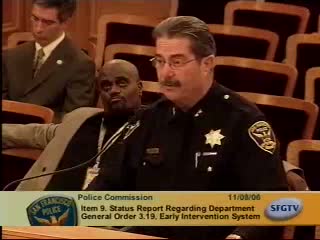
The San Francisco Police Commission heard an extended presentation and debate over General Order 3.19, the department's proposed Early Intervention System (EIS), as staff outlined an RFP and a phased implementation plan.
Deputy Chief Keohane told the commission the department issued an RFP on Nov. 1 seeking technology vendors; notice-of-intent-to-bid forms are due Dec. 4 and staff expect to initiate an EIS unit on Dec. 15, with contract negotiations targeted to conclude in early February 2007. Keohane said the draft order removes certain footnotes and that a separate bureau order will track canine (K-9) activity.
The draft proposes tracking uses of force, citizens'complaints and other indicators and producing quarterly aggregate reports. Keohane said quarterly reports will cover a two-year window but that for disciplinary review the department can consider material up to five years back pursuant to applicable law, and that the system is designed to flag trends for supervisory review rather than impose automatic discipline.
Civil-rights and oversight advocates urged stronger public transparency for serious cases. Mark Schlossberg, Police Practices Policy Director for ACLU Northern California, recommended limiting the use of private stipulated dispositions for serious punishments and asked the commission to preserve public confidence by ensuring sufficient public information for high-suspension cases.
Union representatives said the EIS must align with collective-bargaining obligations. Steve Johnson of the Police Officers Association (POA) urged that Office of Citizen Complaints (OCC) items be screened by the OCC's preliminary-investigation process before they count as EIS inputs; John Tennant, General Counsel for the San Francisco POA, warned that if the POA cannot reach an agreement with the department the union would pursue arbitration under the city charter.
Commissioners pressed staff on several technical points: whether multiple filings arising from the same incident (for example, a vehicle accident that becomes a tort claim, civil suit and OCC complaint) would count as multiple EIS points; Keohane said the order intends to count those collectively as one incident for EIS purposes and would clarify that in the final draft. Commissioners also debated whether certain Penal Code categories typically beyond an officer's control (for example, resisting arrest or incidents where an officer is a victim) should be indicators or recorded only as associated factors for later aggregate analysis; staff proposed treating them as associated factors for the first year while data and audits are developed.
Jean Field, acting for the OCC director, and other public commenters urged that the EIS panel include community representation rather than solely department-connected members; Field said the OCC wants to review drafts and provide written comments. Keohane and other staff said meetings for the EIS board would be public and that aggregates, not individual officer names, would be presented to the commission.
Keohane emphasized the EIS is intended as a performance-enhancement tool: supervisors would document reviews that validate appropriate conduct as well as identify patterns that merit training or counseling. The department also plans periodic audits and a letter accompanying the final order will describe the audit timeline and metrics.
The commission did not adopt a final order at the meeting; commissioners asked staff to return with clarifying edits, with written stakeholder comments to accompany the next draft. The department expects to begin a pilot and vendor selection process over the next months, with further commission review before full implementation.