Get Full Government Meeting Transcripts, Videos, & Alerts Forever!
Get email alerts on the Disciplinary Procedures topic
No spam. Unsubscribe anytime.
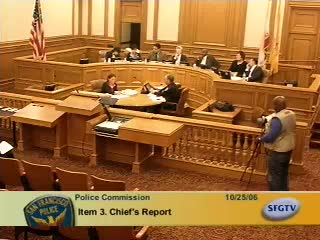
Police commission delays vote on stipulated-disposition rules after POA raises constitutional concerns
Summary
The Police Commission paused consideration of a resolution that would require certain stipulated dispositions of officer disciplinary cases to be handled in public, after the Police Officers Association's counsel argued the measure would condition settlements on waiving constitutionally protected privacy and appeal rights; the commission continued the matter one week to allow further consultation.
The San Francisco Police Commission on Tuesday put off a decision on a proposed resolution that would regulate how stipulated dispositions in officer disciplinary cases are handled, after incoming Police Officers Association (POA) general counsel John Tennant warned the measure could conflict with constitutional and statutory protections for officers.
John Tennant, introduced himself as the POA—s general counsel and told the commission the resolution "seems to fly in the face of the Copley decision." He argued the draft would effectively condition an officer—s ability to settle a case on an ‘‘express waiver of rights,’’ a step he said the state Supreme Court and the California Constitution have previously addressed as protective of peace-officer privacy. "It is a profound misstep you would be taking here to adopt this resolution," Tennant said.
Why it matters: The dispute puts transparency and public oversight — the commission—s stated goal — in tension with legal protections often asserted by officers and their unions. Tennant flagged three legal touchstones repeatedly cited during the discussion: the Copley decision, Penal Code section 832.7 (personnel confidentiality), and the state—s Peace Officers Procedural Bill of Rights. He also said the change could implicate the city—s meet-and-confer obligations under state labor law.
Commissioners debated whether conditioning a settlement on waived confidentiality is legally permissible or whether the commission can require that stipulated dispositions be handled in public so long as statutory rights to a hearing remain intact. Commissioner Petra de Jesus noted that the Copley opinion "specifically did not address whether the public had a constitutional right to attend the hearing" and said the commission is looking for ways to keep hearings open "to whatever extent we can under Copley." Commissioner Theresa Sparks, who has supported the resolution, contended stipulation-based dispositions are a recognized part of appeals practice and questioned whether Copley bars settlements.
Action taken: After discussion, a motion to adopt the resolution was made and seconded. Instead of taking a final vote on the draft, one commissioner moved to continue the item for one week to give the POA time to consult with its membership and suggest revisions; that motion was seconded and carried "without objection." The item was continued for one week.
What the commission said next: Commissioners who defended the resolution emphasized they seek to balance officer privacy with the public—s right to know and monitor police disciplinary outcomes. Commissioner David Campos said transparency, when applied carefully, "underscores what I think most of us know . . . that there are so many officers out there that are doing the right thing." Tennant said he would consult with his client and follow up with the commission.
Next steps: The resolution will return to the commission at its next meeting after the POA has had the requested time to provide suggestions for modifications. The commission did not adopt the resolution at this meeting.
Quotes: "The possibility of a settlement is part and parcel of any appeal process," Tennant told commissioners. "To sort of say, —this is a lesser avenue, so therefore you have to waive a very important right,— that seems inconsistent with the protections the legislature and the voters have adopted."