Get Full Government Meeting Transcripts, Videos, & Alerts Forever!
Get email alerts on the Foot Patrols topic
No spam. Unsubscribe anytime.
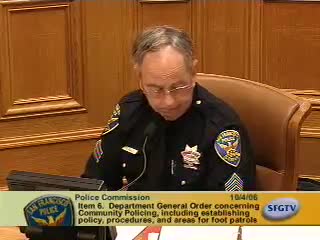
Police commission presses department for numbers as foot-patrol ordinance advances
Summary
The San Francisco Police Commission spent the bulk of its meeting probing whether the police department can meet a proposed ordinance requiring expanded foot/beat patrols. The department said it supports foot patrols but warned staffing shortfalls and 7‑day coverage mandates could reduce motorized patrols and lengthen 911 response times.
The San Francisco Police Commission on Tuesday questioned the Police Department’s capacity to implement a proposed ordinance that would expand mandatory foot patrols across multiple districts, pressing officials for concrete numbers on staffing and response‑time impacts.
Deputy Chief Stanton told the commission the department "is in full support of maintaining all the foot beats within all our police district stations at this time," and said foot patrols are central to community policing. He added the department is "well over 250 officers" short of the minimum staffing level of 1,971 full‑duty officers and that the proposed ordinance — which in places would require beats on two shifts, seven days a week — could force the department to reassign motorized sector cars and increase 911 response times.
Commissioners said they support the concept of more foot patrols but repeatedly asked for specific data to show how much response times would change, where officers would be drawn from and how many additional officers would be required. "If we have to take officers from motorized patrol, it's going to have an effect on the response time," the deputy chief said, explaining trade‑offs between static beat coverage and the wider coverage provided by motorized patrol cars.
The commission reviewed a draft general order (presented as a discussion document) that lists existing foot patrols, attaches maps and would use 18 civilian positions (eight vehicle maintenance roles and 10 police service aide positions) to free sworn officers for street duty. Commissioners pressed for clearer, publicly available figures about weekly shifts covered and how many beats are staffed five or more days per week versus less than five days.
Several commissioners proposed staffing options including civilianization, using DROP (deferred retirement option program) participants, and reassigning non‑critical administrative positions rather than pulling motorized patrol officers off the cars. Deputy Chief Stanton said the department is pursuing civilian hires now — "we've been granted 8 vehicle maintenance officers and 10 police service aids" — and asked for time to present more detailed analyses.
The commission also discussed coordinating with the San Francisco Housing Authority on about $1.5 million previously allocated (and nearly $500,000 more in the budget) for community policing initiatives, with President Louise Rennie proposing a joint meeting to draft a plan for how the funds would be used. Commissioners agreed to continue the item for further review, invite Board of Supervisors members and the mayor’s office, and seek a clearer implementation plan before any formal action.
Next steps: the commission continued the discussion to its next meeting to allow public review of the draft order, to obtain specific department data on staffing and response‑time modeling, and to meet jointly with housing‑authority and supervisory representatives.