Get Full Government Meeting Transcripts, Videos, & Alerts Forever!
Get email alerts on the Police Discipline Transparency topic
No spam. Unsubscribe anytime.
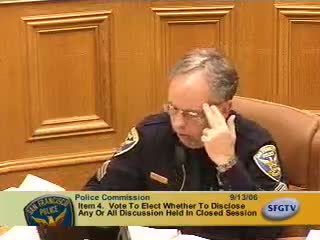
Police commission hears public on Copley Press ruling and whether officer identities should be disclosed
Summary
At a San Francisco Police Commission hearing, legal counsel and community advocates debated the California Supreme Court’s Copley Press decision and whether it restricts naming officers or holding open disciplinary hearings; witnesses urged preserving transparency while commissioners sought legal clarity.
The San Francisco Police Commission on Sept. 11 held a public hearing to consider the California Supreme Court’s Copley Press v. Superior Court decision and whether it requires changes to the city’s practice of holding public disciplinary hearings and disclosing officer identities.
Carl Olson of the San Francisco Chronicle told the commission that the decision "is nothing breathtakingly new" and that San Francisco’s longstanding public hearings and disclosure practices have coexisted with state statutes. "It ain't broke, so don't fix it," Olson said, urging the commission not to narrow public access.
Jim Queen of the African American Police Community Relations Board and Dawn Edwards of Bay Area Police Watch (part of the Ella Baker Center) told commissioners that openness builds trust and that withholding officers’ names in misconduct cases would undermine public confidence. "We want those cops held accountable," Edwards said, arguing that complainants need to see concrete outcomes.
Elizabeth Zifkin of the ACLU’s San Francisco chapter said the ACLU supports open hearings and urged the commission to ask the Board of Supervisors and mayor to seek legislative change to clarify the law statewide. Zifkin also noted community concern about case backlogs and the time it takes to resolve sustained complaints.
Commissioners asked detailed legal questions about whether Copley Press requires nondisclosure of an officer’s name, or of the existence of a complaint, and whether holdings under the Public Records Act translate into rules for live public hearings. Counsel and witnesses repeatedly cited footnote 27 of the court’s opinion, which the Supreme Court said did not decide whether the public has a constitutional right to attend appeal hearings. Commissioners pressed for practical guidance: how the commission can hold meaningful public hearings if identifying information must be withheld, and whether officers could choose to waive confidentiality and have an open hearing.
There was no change in policy made at the meeting. Multiple speakers urged the commission to preserve San Francisco’s open hearings and to work with the mayor and Board of Supervisors to seek legislative clarification. The commission moved the matter into closed session later in the evening to consult with legal counsel about litigation and the decision’s implications.
Next steps: the commission voted to go into closed session to consult with legal counsel and later continued discussion to a future meeting; no formal policy revision was adopted at this session.