Get Full Government Meeting Transcripts, Videos, & Alerts Forever!
Get email alerts on the Police Discipline topic
No spam. Unsubscribe anytime.
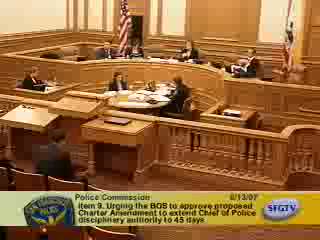
Police commission pauses vote on charter amendment that would let chief suspend officers up to 45 days
Summary
Supervisor Ellsberg presented a charter amendment to let the police chief suspend officers up to 45 days (current limit 10). Commissioners and public commenters raised concerns about oversight, OCC notification, transparency under the Copley decision and unintended consequences; the commission continued the item for at least one week.
The San Francisco Police Commission on June 13 paused consideration of a proposed charter amendment that would let the police chief suspend an officer for up to 45 days without the commission—s review.
Supervisor Ellsberg, who asked that the item be taken out of order, said the two-page amendment responds to three problems: a heavy disciplinary docket that slows other commission work, a need for the commission to focus on big policy issues, and low rank-and-file morale tied to uncertainty about discipline. "This proposal would allow the police chief to suspend officers up to 45 days," Ellsberg said, adding that anything longer would remain with the commission.
Supporters said the change would speed resolution of routine matters and free the commission to focus on policy. Commissioner Marshall told Ellsberg the system is "slow, cumbersome" and that "anything that speeds up the process" is welcome. Several speakers said 45 days is consistent with timeframes for off-duty DUI investigations and recommended using a disciplinary matrix or guidelines to keep serious cases out of the chief's unilateral authority.
But civil-rights advocates and multiple commissioners urged additional safeguards. Mark Schlossberg, police-practices policy director at the ACLU of Northern California, opposed the amendment as drafted, saying it would "reduce the ability of the OCC to verify and file charges" and could mean fewer public disclosures of outcomes if Copley remains controlling law. "Changing that 10 to 45 days with regard to notification of the Office of Citizen Complaints should not be removed from the charter amendment," Schlossberg said, urging written language that ensures cases between 10 and 45 days still become part of the commission—s records.
Other speakers at public comment highlighted broader concerns about transparency and police interactions with people with mental illness, and several asked the commission to move cautiously. Michelle Mongevissari, who identified herself as the mother of a man killed in an interaction with police, urged the commission to implement Prop H and to "reverse Copley," and listed names of people killed in police encounters to underscore the human stakes.
Commissioners suggested technical fixes and process protections: require the department to notify the OCC when suspensions fall between 10 and 45 days, add a timeline by which the chief must act so OCC can review, require monthly case reporting to the OCC (sustained counts and actions), and consider limiting the 45-day authority for officers with recent sustained findings. Several commissioners preferred placing detailed procedural rules (timelines, reporting) in general orders or ordinances rather than the charter itself, to avoid hard-coding operational detail into the city—s constitution.
Ellsberg noted one minor drafting correction: the charter section covers both police and fire and should read "commissions." He also said the proposal would be heard at the Board of Supervisors— rules committee and that there would be time for amendments.
After public comment and discussion, the commission voted without objection to continue the matter for a minimum of one week pending written comments and technical edits from the Office of Citizen Complaints, the Police Officers— Association and others. The commission—s president asked that the OCC and the POA submit comments quickly so the body could consider them before the Board of Supervisors' next hearings.
The commission did not adopt the charter amendment at the meeting. The rules committee was scheduled to consider the item the following day; the commission asked for written input and drafting corrections before returning the matter to its agenda.