Get Full Government Meeting Transcripts, Videos, & Alerts Forever!
Get email alerts on the Community Choice Aggregation topic
No spam. Unsubscribe anytime.
San Francisco CCA workshop: staff to issue RFI, commissioners press for market proof before bond financing
Summary
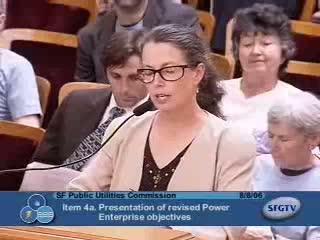
At a second SFPUC workshop the power enterprise outlined Community Choice Aggregation (CCA) objectives and a $5 million budget to develop an implementation plan. Staff will issue an RFI and RFP, but commissioners demanded clearer market tests and revenue assurances for any bond-backed financing before committing to large-scale rollout.
The Public Utilities Commission devoted substantial time to Community Choice Aggregation, a California-statutory model that would let the city procure generation and energy-efficiency services while PG&E continues transmission, distribution and billing.
Assistant General Manager for Power Barbara Hale said the commission's six objectives'reliability, greener supply, lowest net cost, local control, energy efficiency and self-sustaining operations'should guide CCA design. She outlined a proposed portfolio the city is considering and told the commission staff has included a $5,000,000 allocation in this year's budget to support further development of the program and an implementation plan.
Paul Fenn, executive director of Local Power, described the portfolio and risk mitigation: a rollout that includes distributed generation, 31 megawatts of solar PV target, extensive energy-efficiency measures and a 150-megawatt wind component in the plan presented to the commission. He noted AB 117 and CPUC rules require supplier bonding or other protections to cover the risk if customers must be involuntarily returned to PG&E.
The public comment record was overwhelmingly supportive of CCA and large-scale renewables; representatives from the Sierra Club, Greenpeace, Local Power and other local advocates urged quick RFI/RFP action to capture vendors and to avoid potential increases in PG&E exit fees.
Commissioners then debated sequencing and financial risk. Several commissioners insisted staff must use the RFI and RFP to test whether sufficient customers will join and whether bidders can support long-term bond financing. Commissioner concerns focused on the revenue needed to underwrite bonds (staff referenced a revenue model in which annual revenues could be on the order of $225,000,000 and bond issuance might approach $600,000,000 plus interest) and on opt-out behavior during the statutory 120-day notice period.
Barbara Hale and other staff said the implementation plan required by CPUC (per AB 117) would not be submitted until after market input is gathered; staff described the RFI as the appropriate next step before any final implementation-plan filing. Commissioners asked staff to return with comparative studies of CCAs elsewhere (Cape Light Compact, Ohio, Massachusetts), the Nixon Peabody analysis mentioned by staff, and specific proposals to demonstrate probable customer participation (market-testing methods, letters of intent or other commitments) before approving long-term financing decisions.
The commission took no binding financing vote at the workshop. It approved near-term administrative steps'hiring positions, issuing an RFI and drafting documents'but several commissioners emphasized that a formal "go/no-go" decision must follow RFI/RFP results and more detailed revenue and opt-out analysis.
What's next: staff will issue an RFI and return with results, comparative CCA studies and a detailed plan to demonstrate the likely customer base and revenue streams required to support bond financing. No long-term contracts or bond issuances were authorized at the workshop.