Get Full Government Meeting Transcripts, Videos, & Alerts Forever!
Get email alerts on the Community Policing topic
No spam. Unsubscribe anytime.
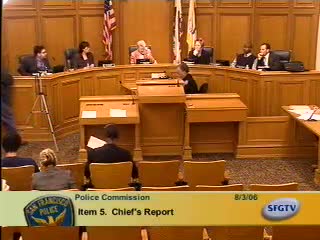
Police commission backs supervisor’s foot-patrol pilot and district-boundary review, urges caveats on staffing and public input
Summary
The commission endorsed recommendations to the Board of Supervisors on two ordinances: a 10-year review of police district boundaries and a one-year pilot requiring foot-patrols in parts of District 5, while asking for clearer language on the commission’s role, earlier public input and budget/expert resources.
The San Francisco Police Commission on Aug. 3 voted to endorse and make recommendations to the Board of Supervisors on two related ordinances: one that would require a 10-year review of police district station boundaries and another that would fund a one-year pilot program for foot-beat patrols in parts of the Northern and Park Police Districts.
Supervisor (District 5) presented both measures, saying a scheduled review of district boundaries is long overdue and that a focused, one-year foot-patrol pilot would help rebuild community trust in neighborhoods with sustained tensions. "I want to see a citywide policy that returns back to foot-and-beat patrols," the supervisor said, proposing District 5 as a pilot area and framing the effort as a measured test intended to produce data to inform citywide policy.
The police chief told the commission the department supports foot beats but warned staffing shortfalls make sustained citywide implementation difficult. The chief said many current foot beats rely in part on violence-reduction supplemental funding and overtime and stressed that the department would not "pull people off of a sector car to put in a foot beat" without appropriate backfill. He recommended identifying priority beats and supplemental funding rather than depleting response resources.
Commissioners pressed for clarity on three points before sending recommendations: confirm the commission’s statutory role in drawing boundaries, require community input earlier in the review process (not only at the end), and build in budget/expert resources for any review or pilot. Several commissioners also asked for a mid-pilot community hearing and for the department to return promptly if staffing or funding constraints hinder implementation.
Public commenters were split: some community members and the African American Police Relationship Board endorsed a pilot in the Western Addition as a trust-building step; other commenters, including neighborhood representatives and an automation/residents association leader, warned the ordinance could be perceived as politicizing police resources and urged more discussion on operational impacts.
The commission moved and seconded a recommendation to the Board of Supervisors to advance both ordinances with the noted caveats; the motion was agreed to in open session. The chief and supervisor agreed to continue refining implementation details and to work with the city attorney and captains on beat configuration and funding.