OCPA reports audits, disallowances and whistleblower volume; new Prop D rules highlighted
Loading...
Summary
The Department—s Office of Compliance and Privacy Affairs presented annual compliance training, said disallowances were a little over $500,000 and described a shift to agency-level audits that lowered error rates; the office also outlined whistleblower and privacy incident processes and explained changes under Prop D.
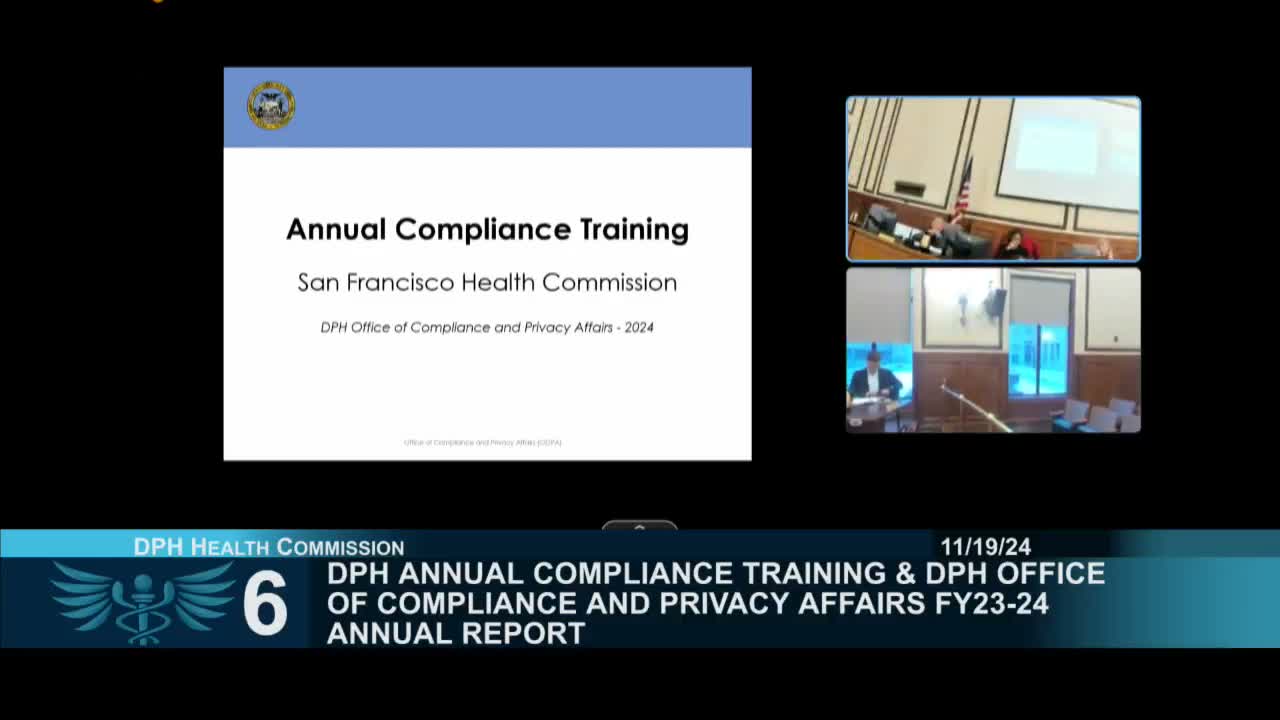
Garrett Chatfield, deputy director of the Department of Public Health—s Office of Compliance and Privacy Affairs (OCPA), gave the Health Commission an annual compliance-and-privacy briefing that covered training, audit results, disallowances, whistleblower referrals and recent changes under Proposition D.
Chatfield summarized the compliance program using the federal "seven elements" framework (compliance officer/committee, policies, line of communication, education and training, monitoring, response and discipline). He said OCPA conducts internal reviews to reduce fraud, waste and abuse and that last fiscal year disallowances totaled "a little over $500,000." He also described federal and state authorities that guide the work, including the False Claims Act, the Fraud Enforcement and Recovery Act and Medi-Cal related rules such as the Deficit Reduction Act.
OCPA reported changes in behavioral health auditing: the office shifted to agency-level audits (143 agencies audited this fiscal year) and said the aggregate error rate observed in those audits was about 13%, an improvement from prior years. Chatfield said OCPA has increased outreach and now runs monthly provider-integrity meetings to review findings and provide guidance.
The office addressed privacy incidents and penalties, noting that 203 incidents were reviewed, 37 of which became reportable to state or federal authorities. Chatfield warned that some fines reported this year relate to 2020 breaches being processed now by the state.
On whistleblower protections, Dr. Palmer asked for clarity about protections and feedback to reporters; Chatfield explained the Controller—s hotline and confidentiality practices, said roughly two-thirds of controller complaints are routed to OCPA, and encouraged nonanonymous reporting when possible so reporters can receive follow-up, while affirming that anonymous reporting remains an option.
Chatfield closed by summarizing Prop D changes that affect city officers and employees (effective Oct. 12): expanded gift restrictions, broader financial-interest filings and additional annual ethics training for all Form 700 filers, plus a stricter, fault-independent standard for some gift rules. Commissioners thanked OCPA and asked for additional program-level audit detail in future reports.
The commission did not take enforcement action during this session; OCPA will supply requested drilldown data and continue monitoring compliance risks.