Get Full Government Meeting Transcripts, Videos, & Alerts Forever!
Get email alerts on the Hospital Annual Report topic
No spam. Unsubscribe anytime.
Zuckerberg San Francisco General presents annual report, honors frontline teams
Summary
Zuckerberg San Francisco General (ZSFG) presented its 2023–24 annual report to the San Francisco Health Commission and recognized several clinical teams — including perinatal care, patient safety, opioid treatment and clinical documentation — for improvements in care quality, safety and revenue capture.
Zuckerberg San Francisco General Hospital presented its 2023–24 annual report to the San Francisco Health Commission and used the commission meeting to honor multiple frontline teams for clinical and operational achievements.
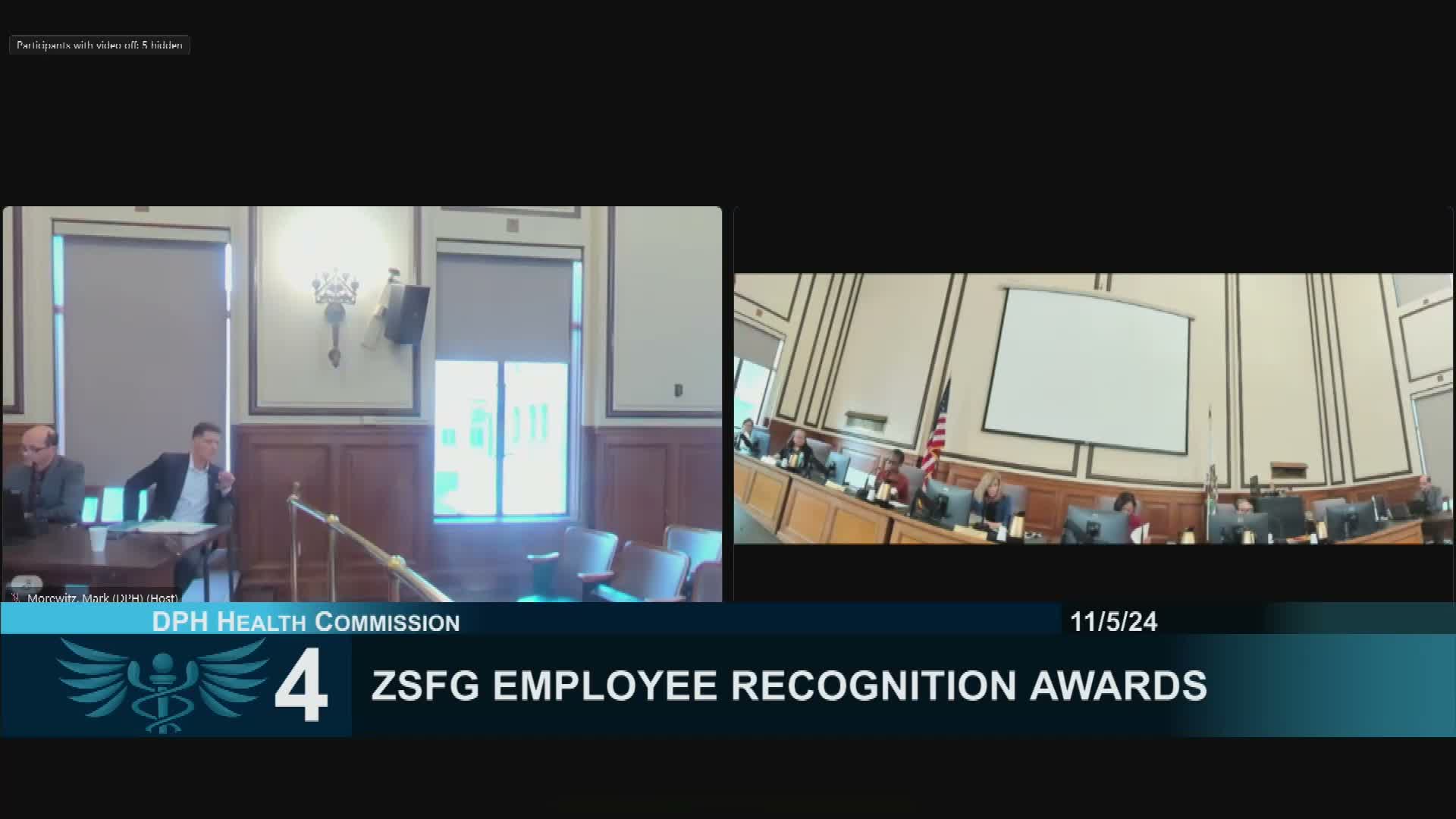
"This is an exceptional institution with exceptional people," President Green said as commissioners read awards recognizing the perinatal leadership team, the patient-safety task force, the Opioid Treatment Outpatient Program and the clinical documentation integrity (CDI) team.
The report, delivered by Dr. Ehrlich, described ZSFG as the city’s primary trauma center and its only 24/7 psychiatric emergency service serving San Francisco and northern San Mateo County. Dr. Ehrlich said the hospital served about 101,759 patients in 2023–24 and employs roughly 5,800 DPH and UCSF staff on campus. She told the commission the hospital’s operating budget is about $1.2 billion and that most revenue comes from public payers, including Medi‑Cal and Medicare.
Commissioners and presenters highlighted several program-level accomplishments: the perinatal leadership team’s equity toolkit and unit training aimed at lowering obstetric racism; a fall‑prevention and safe‑patient‑handling task force that reported one fall with injury in the first half of 2024 in targeted units; and OTOP’s expanded intake work for people with opioid and fentanyl use disorders. Commissioner Chung said OTOP completed more than 600 intakes in 2024 to date and reported a roughly 45% increase in counseling caseloads.
Commissioner Guillermo praised the CDI team for strengthening documentation and revenue capture. The transcript presentation reported monthly revenue increases—from figures cited in the slides as roughly $100,000–$400,000 per month to nearly $1,000,000 per month—and a rise in annual revenue from about $1 million in 2019 to roughly $20 million more recently; the meeting discussion treated those figures as illustrative of improved documentation and funding recovery.
The annual report also reviewed honors and accreditation milestones, work on violence prevention and staff wellness programs, and dozens of campus building projects including seismic upgrades and an expanded psychiatric emergency service. Commissioners thanked hospital leaders and asked for continued updates on key projects such as an adolescent inpatient psychiatric unit under development.
The presentation concluded with commissioners’ remarks of thanks and no formal public comment on the annual report item. The commission moved on to subsequent agenda items after the recognition ceremony.