Get Full Government Meeting Transcripts, Videos, & Alerts Forever!
Get email alerts on the Substance Use Research topic
No spam. Unsubscribe anytime.
City researchers: stimulant-only deaths often linked to cardiovascular disease; fentanyl dominates opioid deaths
Summary
CISA researchers told the Health Commission that most opioid acute-toxicity deaths in San Francisco are now fentanyl (about 96% of opioid deaths) and that many stimulant-only deaths show pre-existing cardiovascular disease; researchers urged different prevention approaches for stimulant deaths.
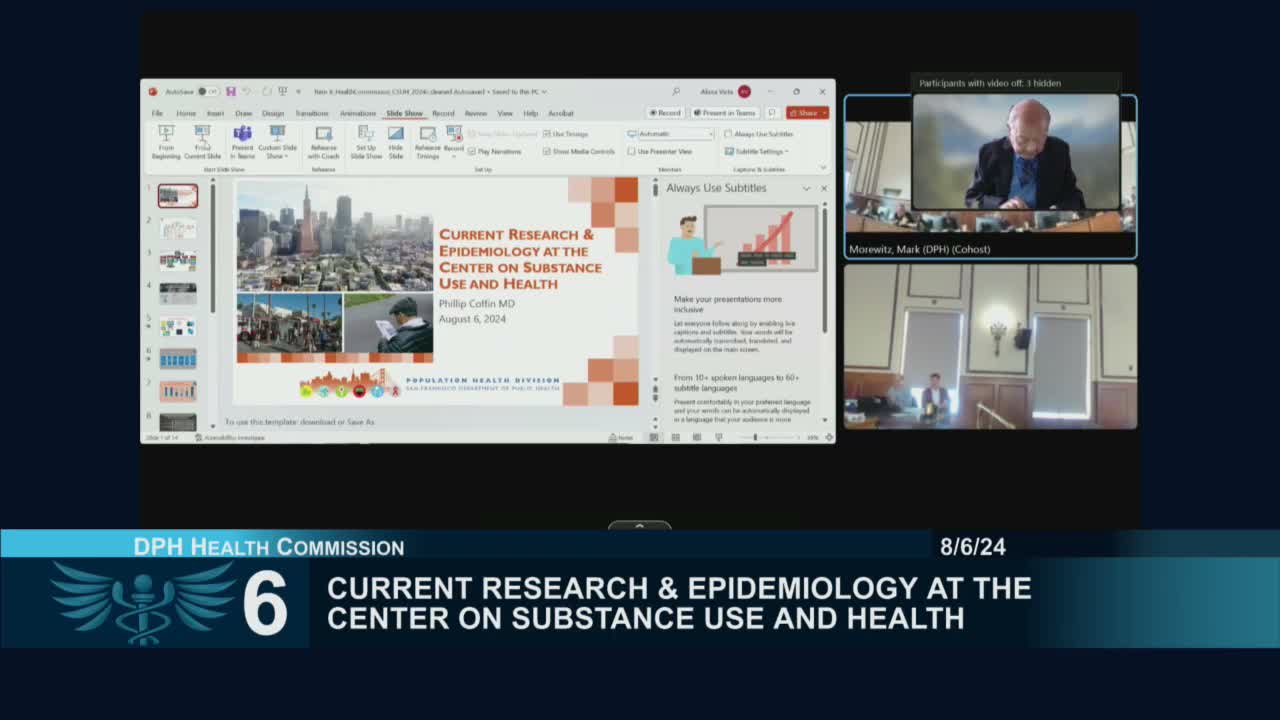
Dr. (Kaufman/Coffin) presented ongoing research from the Center on Substance Use and Health (CISA), summarizing trials and epidemiology that differentiate opioid/fentanyl deaths from stimulant-related fatalities.
"It is also almost entirely fentanyl. 96 percent of the opioid deaths are attributed to fentanyl," the presenter said when describing 2023 data. The presentation noted that opioid-fentanyl deaths typically behave as acute respiratory arrests amenable to bystander naloxone, whereas stimulant-only deaths often present as chronic cardiovascular events: "When we look at the stimulant only, 94 percent had evidence of cardiovascular disease prior to their death. Everyone dying from stimulants without opioids has cardiovascular disease, basically," the presenter said.
CISA staff reviewed multiple programmatic trials (REBOOT, CHOW, CURB-2, M3, PRIME, HINT and LASSO) and described several translational activities, including trials of injectable naltrexone for people who use stimulants to reduce unintended opioid overdoses, and lower-threshold statin prescribing as a preventive strategy for people who use stimulants. The research team argued that stimulant-only deaths may require chronic-disease prevention approaches rather than only bystander naloxone distribution, because many stimulant-only fatalities occur unwitnessed in private spaces.
Commissioners thanked the team and asked about funding and national collaboration; researchers said the work is largely NIH- and CDC-funded and that grant competition is intense but collaborations and trial networks are active.
What happens next: researchers expect additional analyses and continued grant-supported trials exploring medications and prevention strategies specifically targeted at stimulant-related morbidity and mortality.