Get Full Government Meeting Transcripts, Videos, & Alerts Forever!
Get email alerts on the Healthcare Accountability Ordinance topic
No spam. Unsubscribe anytime.
Health Commission unanimously adopts revised Healthcare Accountability Ordinance standards for 2025–2026
Summary
The San Francisco Health Commission approved revisions to the Healthcare Accountability Ordinance minimum standards designed to increase plan availability for small employers while requiring employers to cover a portion of in-network out-of-pocket costs; commissioners voted unanimously to adopt the package.
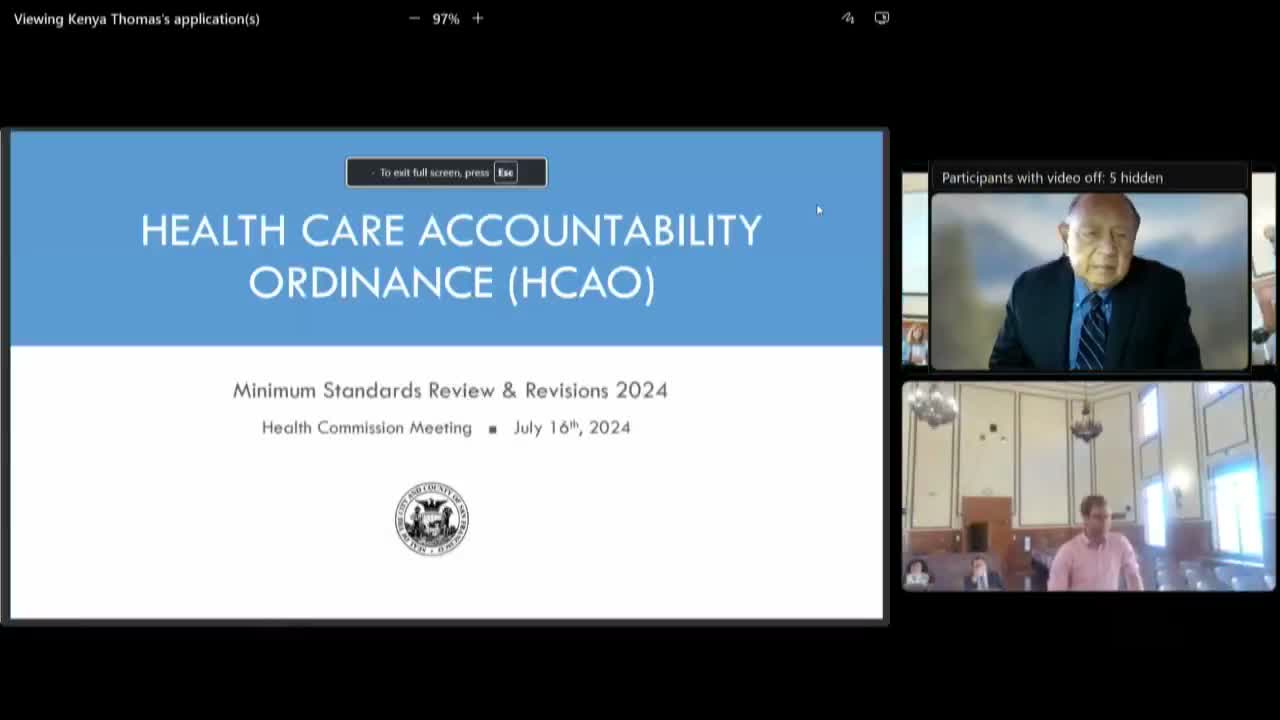
The San Francisco Health Commission voted unanimously to adopt revisions to the Healthcare Accountability Ordinance (HCAO) minimum standards for 2025 and 2026, measures the Department of Public Health said will expand the number of compliant small-group plans while preserving employer-paid coverage for richer plans.
Max Gara, health program planner in the Office of Policy and Planning, presented the package and walked commissioners through the work-group process, data analysis and the proposed changes. "The purpose of today's presentation is to share recommendations for revisions to the Healthcare Accountability Ordinances minimum standards for 2025 and 2026," Gara told the commission. DPH evaluated 178 small-group plans across nine carriers in the second quarter of 2024 to inform the recommendations.
Why it matters: DPH said only gold or platinum plans and roughly a third of silver plans met the current standards in its market review, down from about 70% in 2022. The department proposed adjustments intended to increase silver-plan availability to roughly 77%, while keeping gold and platinum plans compliant when employers fully cover premiums and deductibles.
Key provisions described by DPH include: retaining the requirement that employers fully cover plan premiums for gold and platinum plans; syncing the out-of-pocket maximum benchmark to the federal out-of-pocket limit (DPH cited $9,200 for 2025) and maintaining a framework under which employers must cover 50% of in-network out-of-pocket medical expenses (DPH used an example in which an employer would cover $4,600 of a $9,200 out-of-pocket maximum); raising the prescription drug deductible cap from $300 to $400; and increasing primary-care visit copay limits from $60 to $65. DPH also proposed an adjustment to the coinsurance standard; the department presented analyses showing that the overall package would increase the share of compliant silver plans, though the transcripted wording of the exact coinsurance split was unclear.
Work-group process and stakeholder input: Gara said a 13-member work group (employers, labor, brokers, plans and city agencies) met in May and June and reached consensus on 15 of 16 proposed minimum standards. Debbie Lerman of San Francisco Human Services Network, a work-group member, urged adoption and asked DPH to expand employer education about how nonprofits can use reimbursement accounts and preloaded cards to reduce out-of-pocket burdens.
Questions from commissioners focused on employer supports and guidance: Commissioner Chao thanked staff for "thoughtful answers" and asked what concrete, unbiased help the department will provide employers trying to choose plans. Gara said DPH will publish standards, FAQs and webinars and work with the Office of Labor Standards and Enforcement to field questions and walk employers and brokers through compliance options.
Vote and next steps: Chair moved the recommendation, a commissioner seconded, and a roll-call vote recorded yes votes from Commissioners Green, Christian, Salgado and Chao. The resolution was approved unanimously. DPH said it will publish the adopted standards and host education events for businesses that contract with the city.
What the action does not do: The changes do not eliminate the requirement that employers fully cover premiums for gold and platinum plans. Where DPH did not provide an exact coinsurance split in clear transcript text, the department—s analysis showing plan-availability effects was cited instead. DPH said more detailed implementation guidance will be provided to employers and brokers.